We research, compare, and evaluate every product we recommend, and only describe a pick as directly tested when that is specifically documented. As an Amazon Associate I earn from qualifying purchases. When you buy through our links we may earn a commission -- at no extra cost to you. Full disclosure.
Compare Options
A kids room presents a storage challenge that no other room in the house matches: the contents change constantly as the child grows, the person using the room is not the one buying the organization system, and the system has to be simple enough for a child to maintain independently -- or it will not be maintained at all. Most kids room organization failures happen because the system was designed for the adults, not the child.
The right kids room storage works at the child's eye level, uses containers that are easy to open and close without help, and assigns every category of toy and supply to a clear, consistent location. Done correctly, a child can put their own room back in order in 10 minutes. Done incorrectly, even the most beautiful organization system becomes an overcrowded disaster within a week.
What You Will Need
Before starting, gather:
- 3 large bins or trash bags for Sort, Donate, and Trash
- Measuring tape
- Labels or a label maker
- Storage bins sized to the child's reach height
- A bookshelf, cube organizer, or shelving unit appropriate for the room
Step 1: Empty Everything and Sort by Keep, Donate, Trash
Pull every item out of the room -- toys, books, clothes, art supplies, sports gear, and anything else stored there. Sort into three categories as you go: Keep (age-appropriate and actively used), Donate (outgrown or unused), Trash (broken, missing pieces, or genuinely worn out). Do not let the child make every decision alone -- outgrown toys and broken items should be removed regardless of protest. The goal is to right-size the room's contents before organizing anything.
A typical purge removes 20 to 40 percent of a child's toy inventory. This step is not optional -- organizing a room that is overstocked with toys that do not get played with just creates a larger, better-labeled pile of clutter.
Step 2: Categorize What Remains
Group everything that is staying into categories. Common kids room categories:
- Active toys (building sets, action figures, dolls, vehicles)
- Art and craft supplies (crayons, paper, scissors, glue)
- Books
- Dress-up and costumes
- Board games and puzzles
- Sports and outdoor gear
- Stuffed animals
Each category will get its own container or zone. The goal is one category per bin -- mixing categories is how systems fall apart.
Step 3: Measure the Room and Plan Zones
Measure the room's floor space, wall dimensions, and existing furniture footprint. Identify where the natural zones are:
- Play zone -- floor space for active play, close to toy storage
- Reading zone -- bookshelf near a light source, comfortable seating nearby
- Art zone -- desk or table with art supply storage immediately adjacent
- Clothing zone -- closet or dresser, ideally separate from the play area
Zone-based room layout prevents toys from migrating into every corner by giving each activity a physical home.
Step 4: Choose Age-Appropriate Storage
Storage height is the most important factor. For children under 6, all active toy storage belongs below 36 inches -- accessible without climbing or asking for help. For children 6 to 12, storage up to 60 inches is reasonable. For teens, full-height furniture works.
The best formats by category:
- Toys -- open bins with picture labels (for pre-readers) or word labels. Cube organizer units work well.
- Books -- front-facing bookshelf so covers are visible and titles are identifiable. Standard shelving often means books are spine-out and ignored.
- Art supplies -- clear desktop organizers so supplies are visible; keeps pencils, markers, and scissors separated.
- Stuffed animals -- hammock net mounted in a corner high up; keeps stuffed animals out of the floor zone while staying accessible for nighttime.
- Board games and puzzles -- shelf above accessible toy level; games require adult setup assistance, so less critical to be at child height.
Step 5: Label Everything for the Child
Labels are what make a kids room system maintainable. For children who cannot read yet, use picture labels -- a photo of the toy type that goes in each bin, printed or hand-drawn and taped to the front. For readers, word labels are enough. The label answers the question "where does this go?" for both the child and any caregiver helping with cleanup.
Label the shelf or zone as well as the bin. A bin labeled "LEGO" sitting on a shelf labeled "Building Toys" creates two layers of guidance -- the child learns the category as well as the specific bin location.
Step 6: Involve the Child in the Setup
Let the child participate in placing their items in their new storage locations. A child who helped set up the system knows where things go and has some ownership over maintaining it. This is not about letting the child make all the decisions -- it is about ensuring they understand the system well enough to use it independently.
Walk through the cleanup routine together once before declaring the setup complete: "Where do the building toys go? Show me." If the child cannot remember after two prompts, the system is too complex and needs to be simplified.
Step 7: Teach and Practice the Cleanup Routine
A kids room organization system only works if the cleanup routine is practiced until it is automatic. Set a consistent cleanup time (before dinner, before bed, or both) and do cleanup together for the first two weeks. After two weeks of supervised cleanup, the child should be able to do it independently.
The routine should take no more than 10 to 15 minutes for a properly organized room. If cleanup regularly takes longer than 20 minutes, the room has too many items or too many categories -- purge again and simplify.
Step 8: Adjust for Age as the Child Grows
A kids room organization system is not permanent -- it should be reassessed every 6 to 12 months. Toys that were age-appropriate at 5 are often outgrown by 7. Storage heights that worked for a 4-year-old are too low for an 8-year-old. Annual or biannual reassessments of both the contents and the storage format keep the system matched to the child's current needs rather than who they were two years ago.
Our 8 Favorite Kids Room Storage Products
6-Cube Kids Storage Shelf
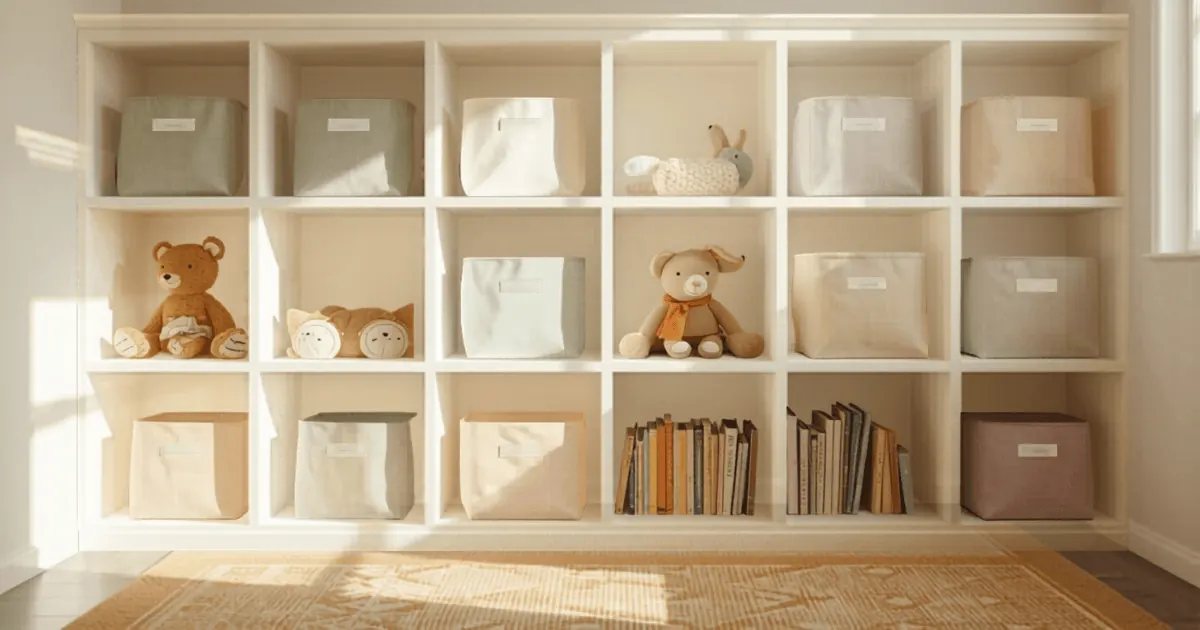
The 6-cube unit is the best base for a kids room toy storage system -- each cube fits a standard storage bin, the unit is adjustable for height placement, and the modular format lets you add cubes as the child's inventory grows. Position it low on a wall with fabric bins in each cube, labeled by toy category. This single piece of furniture organizes most of a young child's toy inventory in one place.
Stuffed Animal Corner Hammock
A hammock net mounted in the corner above the bed solves the stuffed animal problem permanently. Animals stay off the floor and bed, remain visible and accessible, and the net expands to hold a significant collection without any shelf space. Mounts with four hooks into wall studs -- installation takes 10 minutes.
Kids Desk Supply Organizer
Clear compartments sized for crayons, markers, scissors, and tape keep art supplies organized on a desk or table without requiring a child to search through a messy drawer. The Melissa and Doug version has durable construction designed for active use by children, with labeled compartment sections in kid-friendly sizing.
Front-Facing Kids Bookshelf
Front-facing bookshelves display book covers instead of spines, which dramatically increases a young child's engagement with their book collection -- they can identify books by cover art before they can read titles. The Guidecraft version is sized for picture books and early readers, sits at a height accessible to children 3 to 8, and is sturdy enough to survive daily use.
Small Drawer Tower
For older kids (5 and up), a small drawer tower on the desk or dresser top creates organized homes for small toy parts, art supplies, and hobby items. Each shallow drawer holds one category without the contents getting mixed up. The translucent plastic shows contents without opening -- useful for quick-find cleanup. The compact footprint means it works on any desk surface.
11-Inch Fabric Cube Bins
Standard 11-inch fabric cube bins pair with the SONGMICS organizer (or any cube shelf unit) to convert open cubes into concealed storage. The fabric construction makes them lightweight enough for a child to pull out and carry to the play area, and they collapse flat when not in use. Buy one set in each of two colors to color-code categories -- for example, blue bins for toys and grey bins for books.
Over-the-Door Pocket Organizer
An over-door organizer on the bedroom door or closet door adds instant storage for shoes, rolled art projects, sports bottles, and supplies without taking any floor or shelf space. For kids rooms, the lower pockets work well for shoes and the upper pockets for lightweight gear. No tools required -- hooks over a standard door in under a minute. See our full guide to the best over-the-door organizers for the complete comparison.
Toy Sorting Box
A dedicated sorting box for building bricks keeps Lego and Duplo from becoming an underfoot hazard. The lid snaps closed for transport to another room and serves as a building surface during play -- a two-in-one design that keeps pieces contained during both play and storage. The sorted compartments inside prevent the dump-and-search approach that slows cleanup.
Kids Room Storage by Age
Ages 2 to 4: Everything Accessible, One Category per Bin
At this age, every storage item should be reachable without help and identifiable by picture label. All bins stay below 30 inches. Toy categories should be broad -- "Cars and Trucks" rather than "Hot Wheels" and "Matchbox" separately. The fewer bins, the better: young children cannot maintain a system with more than 5 to 7 distinct storage locations.
Ages 5 to 8: Introduce More Categories and Reading Labels
As fine motor skills develop and reading begins, storage can become more specific and slightly higher (up to 48 inches). Art supplies get their own desk organizer. Books move to a front-facing shelf organized loosely by series or type. Lego and building sets get dedicated bins separate from general toys. The child can participate meaningfully in the organization decisions.
Ages 9 to 12: Transition Toward Teen-Style Organization
At this age, the child can use adult-style organization systems: standard bookshelves, desk drawer organizers, full-height storage. Involve the child heavily in the design -- a system they helped design is one they will maintain. Toy storage transitions toward hobby and project storage (art, sports, gaming, collections).
Ages 13 and Up: Let Them Own the System
Teen storage should be entirely designed with and by the teen. Imposing an organization system on a teenager creates resentment rather than compliance. Provide the budget, discuss the space constraints, and let them make the storage decisions. The system may not be what you would choose -- but it will be one they maintain.
Frequently Asked Questions
How do I get my child to keep their room clean after organizing it?
The system has to be simpler than the mess. If cleanup requires more than 10 to 15 minutes and more than 5 to 8 bin destinations, it will not be maintained consistently. Simplify by reducing total item count and total storage categories. A 10-minute cleanup routine that a child can complete independently is infinitely more effective than a complex system that requires adult assistance.
What is the best way to organize Lego and building sets?
For young children (under 7): one large bin for all Lego pieces, sorted loosely by color if at all. For older children who build from instructions: separate shallow bins or drawer units for sorting by piece type. The level of organization should match the child's actual building style -- a child who dumps and sorts will not maintain a compartmented system.
How do I store board games in a kids room?
Stack games vertically (like books) on a shelf rather than flat -- flat stacking means the games on the bottom are never accessed. Use rubber bands or elastic straps to keep box tops secured if the boxes are loose. Store puzzles in ziplock bags labeled with the puzzle name if the original boxes are damaged.
How often should I declutter my child's toys?
Twice per year is the practical minimum: before birthdays and before winter holidays when new items are incoming. A useful prompt is to ask what the child played with in the last three months -- items that have not been touched in 90 days in an age-appropriate room are candidates for donation. Involve the child in the decision where possible, framing donation as giving toys to children who will use them.
The Bottom Line
The most important design principle for a kids room is making cleanup easier than making a mess. Low accessible bins, picture labels, broad categories, and a practiced routine will outperform any expensive storage system that requires adult assistance to maintain. Spend less money on elaborate organization products and more time on simplifying the room's total contents -- a room with the right number of items needs very little storage infrastructure to stay organized.
For more help organizing the full room, see our guides to the best toy storage and playroom organization ideas, over-the-door organizers, desk organizers for shared spaces, and kids closet organizers.