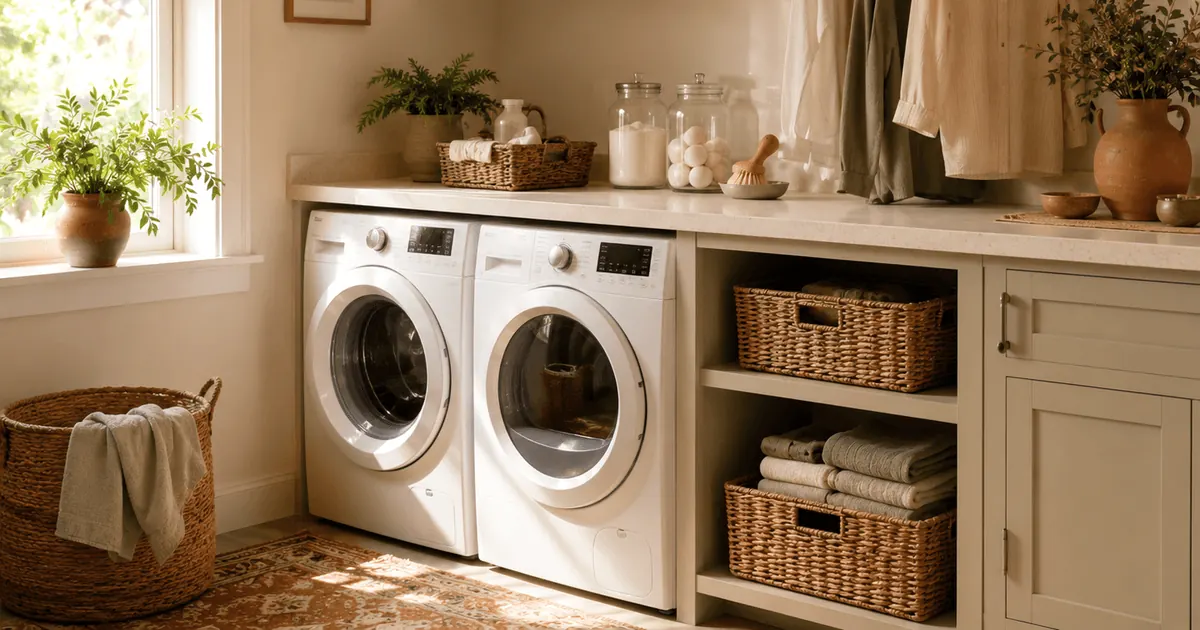
Most laundry rooms are built as an afterthought. You get two appliances shoved into a closet, a narrow strip of wall, and absolutely no flat surface for folding -- the most time-consuming part of the whole process. If you've been hauling baskets of clean clothes to the bedroom couch or piling them on the dining room table, you're not alone. The good news: you don't need a renovation or extra square footage to fix this. You just need a smarter setup.
This guide walks you through exactly how to build a functional laundry folding station from scratch -- even in a laundry closet, a hallway utility space, or a room barely big enough to turn around in.
Why Most Laundry Rooms Have a Folding Problem
The issue usually isn't lack of space -- it's unorganized space. Standard laundry rooms have plenty of vertical real estate above the machines, behind the door, and on side walls that goes completely unused. Add in the habit of using one big laundry basket as both transport and "temporary storage," and you end up with a system that spreads clean clothes across half your house.
A dedicated folding station fixes the bottleneck: the moment between pulling clothes out of the dryer and actually putting them away. When that step has no home, it expands to fill wherever there's a flat surface. Give it a real spot and the entire laundry process gets faster, more contained, and a lot less frustrating.
Step 1: Choose Your Folding Surface
You need a flat surface at roughly waist height. In a small laundry room, you have three realistic options:
Option A: A Rolling Cart as Your Primary Folding Station
A multi-tier rolling cart gives you a solid top surface for folding plus lower shelves for sorted piles or supplies. When you're not actively folding, it rolls to the side. The Compare Options is one of the most practical choices -- it has a wide top shelf for folding, two open lower levels for sorted clothes or supplies, and rolls easily between appliances or along a side wall when not in use.
Look for a cart that's at least 24 inches wide so you have enough surface to fold shirts and pants flat without items hanging off the edge. Carts with locking casters are worth the small extra cost -- they keep the surface stable while you're actually working.
Option B: A Wall-Mounted Drop-Down Shelf
If floor space is truly at a premium -- like in a full laundry closet -- a wall-mounted fold-down shelf is the most space-efficient solution. These hinge down when you need them and fold flat against the wall when you don't, taking up zero floor space in the interim. Install one at waist height above your machines or along any open wall section and you've created a dedicated folding surface from practically nothing.
Option C: Over-Appliance Shelf Extension
If your washer and dryer sit side by side, an over-appliance shelf can bridge the gap between them and extend several inches on one side, creating a continuous work surface. This works especially well with front-loaders where the tops of the machines are already at roughly counter height.
Step 2: Build a Sorting Zone Below Your Station
Every folding station needs a staging area for sorted clothes before they travel back to bedrooms and closets. The biggest mistake is putting everything back into one undivided basket where it all gets jumbled again the moment someone reaches in.
The Compare Options works perfectly as both a pre-wash sorter and a post-fold staging area. Each section holds a different person's clothing, and the rolling base means you can wheel it directly out of the laundry room and to whichever bedroom needs it most. For families with young kids, add a simple label to each section -- a strip of painter's tape and a marker works fine.
If you're organizing by category rather than by person, label sections "put away today," "hang dry," and "needs attention" for things that need buttons sewn on or stains retreated. This gives every piece of laundry a clear next step instead of ending up in a pile somewhere.
Step 3: Claim Your Vertical Wall Space for Supplies
One of the fastest ways to destroy a folding station is letting detergent bottles, dryer sheets, stain removers, and lint rollers creep onto your folding surface. Keep them completely separate by mounting shelving above the station or along the adjacent wall.
Open metal shelving is the most practical choice here -- you can see everything at a glance and adjust shelf heights as needed. A compact unit like the Compare Options gives you enough space for detergent, fabric softener, dryer sheets, and a few spray bottles in a single vertical footprint that doesn't eat into your folding area.
On each shelf, use labeled bins or baskets to group items by type: one bin for washing supplies, one for dryer supplies, one for stain treatment. When everything has a category, restocking is easier and clutter has nowhere to accumulate.
Step 4: Add a Hang-Dry Zone Next to the Station
No folding station is complete without a place to hang items that can't go in the dryer -- delicates, workout clothes, button-down shirts, anything with a "lay flat to dry" tag. Without a designated spot, these items end up draped over chairs, doorknobs, and shower rods throughout the house.
Install a wall-mounted retractable drying rod directly above or beside your folding station, or hang a compact garment rack on the back of the laundry room door. Either option keeps hang-dry items in the laundry room where they belong.
For a freestanding option that tucks away completely, the Compare Options folds flat when not in use and can stand directly beside the dryer during active laundry sessions. It's especially useful for households with a lot of hand-wash or hang-dry items, since you can transfer them directly from the dryer without taking a single step.
Step 5: Set Up a Ready-to-Put-Away System
Folding is only half the job -- clothes still need to make it back to the right room and the right drawer. Without a clear system for this step, folded piles sit on the folding surface indefinitely, which defeats the whole purpose of having a station in the first place.
Stackable drawers labeled by room or family member work better than open baskets here because they create contained, clearly identified storage that makes it obvious what still needs to be carried out. The Compare Options is a practical choice -- fold clothes directly into the appropriate drawer as you work through the pile, and when laundry day is done, carry each drawer to its destination room. This eliminates the "basket sitting untouched for four days" problem because there's no ambiguous basket, just clearly labeled drawers that are either empty or full.
A Complete Small-Room Folding Station Layout
Here's what this setup looks like assembled in a standard laundry closet or compact laundry room:
- Folding surface: Rolling cart positioned between or beside appliances, or a wall-mounted fold-down shelf above the machines
- Supply storage: Open metal shelving above the folding surface with labeled bins for each category
- Sorting zone: 3-section rolling sorter parked beside the folding station
- Hang-dry area: Retractable wall rod or over-door garment rack adjacent to the station
- Put-away storage: Stackable drawer cart labeled by room or family member
The entire setup can be assembled for under $200 and requires no permanent changes to your laundry room. Every piece can be rearranged or taken with you if you move.
The One Rule That Keeps This System Working
The best folding station breaks down almost immediately if it becomes an overflow shelf between laundry days. The rule is simple: the folding surface is for active folding only. Once clothes are folded, they go directly into the sorter or the labeled drawers -- never back onto the surface to deal with later.
Most laundry room chaos happens at exactly this moment: something gets set "just temporarily" on the folding surface, then something else joins it, and within a week the station is buried under clean-ish clothes and random items. Protect that surface consistently and the whole system essentially maintains itself.
You don't need a dedicated laundry room or a remodel to fold laundry efficiently. You need a surface, a sorting system, vertical storage for supplies, and a place for folded clothes to wait before they're put away. Even in a closet-sized space, that combination makes laundry day faster, cleaner, and significantly less likely to take over your couch.
FAQ
How do I create a folding station in a laundry room with no counter?
A wall-mounted fold-down table, a slim rolling utility cart, or a freestanding butcher block table placed beside or in front of the machines all work as folding surfaces without requiring built-in counters. Wall-mounted fold-downs are the best option for very tight spaces because they take up zero floor space when not in use. Any stable, flat surface at roughly waist height will do the job.
What is the cheapest way to add folding space to a laundry room?
A folding utility table or a rolling kitchen island runs $40 to $80 and can be moved out of the way when not needed. If you have a dryer with a flat top, a silicone mat or a cut piece of butcher block laid on top creates an immediate work surface for free. A wall-mounted fold-down shelf bracket with a board cut to size is another low-cost option that stays out of the way between uses.
Can a wall-mounted fold-down table work as a laundry folding station?
Yes, and it is one of the best solutions for small laundry closets and tight spaces. Look for a table rated for at least 50 lbs with sturdy folding legs -- inexpensive versions with thin legs tend to wobble under a full load of towels. Mount it at roughly hip height so you can fold standing up without hunching, and make sure the folded-down clearance still allows the machines to function normally.