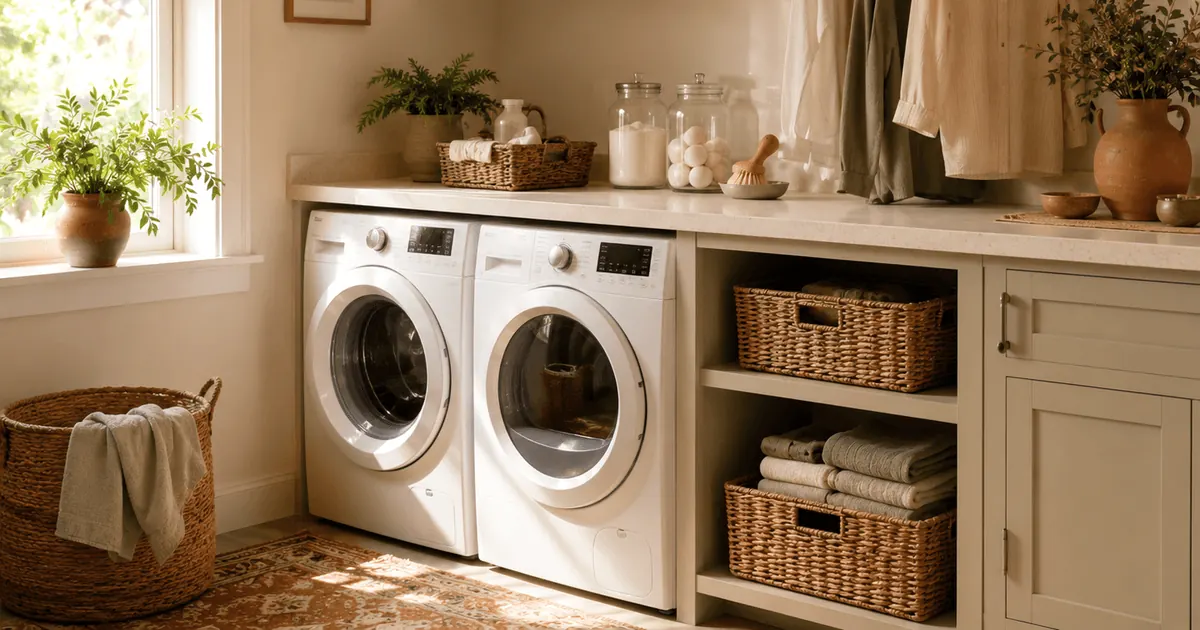
A laundry room without a countertop is far more common than home-design blogs would have you believe. Apartments, older homes, closet-style laundry nooks, and stacked washer-dryer setups all share the same problem: nowhere stable to set a detergent bottle, let alone organize an entire supply collection. The result is usually a pile of bottles balanced on top of the machines, dryer sheets stuffed behind the drum, and stain remover pens that disappear for weeks at a time.
The good news is that counter space is a habit, not a requirement. With the right vertical and door-mounted storage, you can create a fully organized laundry supply system that works better than any flat surface -- and survives the vibration of a spin cycle. Here are seven solutions that work in real laundry rooms, even the smallest ones.
1. Install a Slim Rolling Cart in the Gap Beside the Washer
The narrow space between your washing machine and the wall -- or between the washer and dryer in a side-by-side setup -- is almost always unused. A slim rolling cart turns it into a dedicated supply station with two to four tiers of storage that rolls out when you need it and tucks back in when you don't.
The Compare Options is a perennial favorite for this spot. Its chrome wire construction keeps things from getting damp or moldy if detergent drips, and each tier holds enough weight for large bottles. The casters lock so it stays put during the wash cycle.
What to keep here: Liquid detergent, fabric softener, a measuring cup, a small container of pods for quick loads, and a spray bottle of stain remover.
Before you order: Measure the gap width carefully -- laundry-specific carts run 5-7 inches wide, while standard utility carts are 12-18 inches wide. Most apartment washer-dryer gaps fall in the 6-8 inch range.
2. Mount a Floating Shelf Directly Above the Machines
Even without a countertop, the wall above your washer and dryer is functional vertical real estate. A single 24-inch shelf positioned 12-15 inches above the appliance tops gives you plenty of room for your most-used supplies without getting in the way of the lid or door.
Choose a shelf with a raised front lip -- at least half an inch -- so that vibration from the spin cycle doesn't gradually walk bottles to the edge. Adjustable track systems like the Rubbermaid FastTrack Rail give you the flexibility to add hooks or additional shelf brackets over time without drilling new holes. For renters, tension-pole floor-to-ceiling shelving units work just as well and leave walls untouched.
Shelf loading tip: Put the heaviest bottles at the center of the shelf, not the edges. Evenly distributing weight prevents warping on laminate shelves and keeps the bracket stress balanced.
3. Claim the Back of the Laundry Room Door
The back of your laundry room door -- whether it swings into the space or closes it off from a hallway -- is one of the most overlooked storage surfaces in any home. A well-chosen over-door organizer can hold a full two-week supply of laundry accessories without using an inch of floor or wall space.
The Compare Options hooks over standard-depth doors in seconds without tools. Its deep pockets comfortably hold detergent pods, dryer sheets, wool dryer balls, stain remover pens, and a lint roller. Clear or mesh pocket styles let you see what you have at a glance, so you always know when you're running low.
Best items for door storage: Laundry pods (they're lightweight), dryer sheets, mesh laundry bags for delicates, clothespins, rubber gloves, and spare lint trap filters.
What to avoid: Heavy liquid bottles and full-size fabric softener jugs. The hooks on most over-door organizers are designed for moderate weight -- stick to lighter items here and reserve heavier bottles for the rolling cart or wall shelf.
4. Decant Detergent into Pump Dispensers
One of the fastest ways to make a counter-free laundry room look chaotic is to leave detergent in its original packaging. Those economy-size jugs are unwieldy, the lids get gunky, and the sheer size makes them hard to fit anywhere sensible. Decanting into matching pump dispensers solves all three problems at once.
Transfer your liquid detergent into a dispenser with a measured pump -- one pump typically equals one load -- so you stop over-pouring and save money over time. Use coordinating canisters for pods, dryer sheets, and oxygen booster. When everything is the same size and clearly labeled, it stacks neatly on a shelf or cart tier without looking cluttered.
Keep the bulk refill jug in a lower cabinet, under the utility sink, or in an adjacent closet. Only the dispensers live in your active laundry zone.
5. Use Stackable Clear Bins to Group by Task
Instead of organizing by product type, try organizing your laundry supplies by task: one bin for "everyday wash," one for "delicates and hand wash," one for "stain treatment," and one for "dryer supplies." This system means you only pull out the bin you need for each load, rather than digging through everything every time.
Compare Options work especially well here because the lids snap securely (no accidental spills) and the clear sides let you see what's inside without opening each bin. Stack them on a shelf, in a nearby cabinet, or beside the machines if space allows.
Sample bin contents:
- Everyday wash: Detergent pods, dryer sheets, fabric softener
- Delicates: Woolite, mesh laundry bags, a lingerie bag
- Stain treatment: OxiClean, stain remover pen, white vinegar spray, enzyme spray
- Dryer supplies: Wool dryer balls, anti-static spray, dryer-safe sachets
6. Add a Pegboard Panel to Any Open Wall Segment
If you have even a 2x3-foot section of open wall in your laundry space, a pegboard panel turns it into infinitely customizable storage. Hang wire bins, S-hooks, small shelves, and clip holders in whatever configuration suits your supplies. The entire grid can be rearranged in minutes as your needs change.
Pegboard is especially useful for items you reach for mid-session: measuring scoops, stain spray, a small pair of scissors for snipping loose threads, and dryer balls. Mount it at standing eye level so everything you need during a wash or dry cycle is within arm's reach without bending or searching.
For renters, freestanding pegboard frames and heavy-duty adhesive-mount pegboard systems are available that don't require drilling. Paint the board the same color as your walls to make it blend in rather than stand out.
7. Create a "Top-of-Machine Tray" System
The tops of your washer and dryer aren't a proper countertop, but they can function as one if you contain everything in a shallow, non-slip tray. The tray acts as a physical boundary: anything in the tray is allowed up there, everything else lives somewhere else. This single rule eliminates the slow accumulation of random items that eventually turns the appliance tops into a cluttered catch-all.
The Compare Options is specifically designed for this purpose, with rubber feet to prevent sliding during the spin cycle and a raised lip to keep items corralled. Use one tray on the washer for in-progress items (detergent, stain remover, the current load's settings slip) and one on the dryer for finished-load items (a basket for folding, a cup for spare change found in pockets).
The one rule: When a tray is full, something has to move to another storage zone before anything new goes in. This keeps the system from reverting to chaos within a week.
Building Your Counter-Free System
You don't need to implement all seven solutions at once. Start with the one that addresses your biggest daily frustration -- for most people, that's either the rolling cart beside the washer or a wall shelf above the machines -- and add from there as you identify gaps.
The general framework is straightforward:
- Active supplies (what you use every load) live at arm's reach -- on the cart, wall shelf, or in the tray
- Secondary supplies (stain treatment, delicates wash) live in a nearby bin or on the door organizer
- Backup and bulk purchases live in a labeled bin in a closet or cabinet away from the machines
Within a few wash cycles of setting this up, you'll stop hunting for the stain remover, stop running out of pods without noticing, and stop dreading the sight of your laundry room altogether. The counter space you never had turns out to be something you never actually needed.
FAQ
Where do I store detergent and dryer sheets with no laundry room counter?
Mount a wall shelf 12 to 16 inches above the machines -- this creates a counter-equivalent surface that keeps detergent and dryer sheets at eye level and within arm's reach during every load. If wall mounting is not an option, a slim rolling cart positioned beside the washer serves the same function and can slide under an existing shelf when not in use.
What is the best way to organize laundry pods and softener in a small space?
Store pods in a small lidded container or a dispenser jar placed directly on the wall shelf or rolling cart so they stay contained and easy to grab one-handed. Liquid softener does best in a tray or bin to catch drips and keep the shelf surface clean. Grouping both items together in a single per-load supplies zone eliminates the reaching-around-things problem that happens when supplies are scattered.
Can I mount a shelf above the washer to create counter-equivalent storage?
Yes -- a wall-mounted shelf above the washer is one of the most effective counter substitutes in a counter-free laundry room. Use a shelf rated for at least 30 pounds to safely hold liquid detergent and full containers, and position it high enough that the washer lid opens freely underneath. A bracket-mounted floating shelf or a tension-pole shelving unit are both good options if you cannot drill into the wall.