We research, compare, and evaluate every product we recommend, and only describe a pick as directly tested when that is specifically documented. As an Amazon Associate I earn from qualifying purchases. When you buy through our links we may earn a commission -- at no extra cost to you. Full disclosure.
The mudroom is where organization either holds or collapses. It is the first point of contact when you walk in and the last thing you interact with on the way out. Most mudroom setups fail not because they are too small but because they are too rigid. A system that works for two adults will not work for a family of five, and a system designed around ideal behavior will not survive real daily traffic. The right mudroom setup is built around how your household actually moves, not how it should move.
Quick Overview: Mudroom Storage by Item
| Item |
Best Storage |
Key Feature |
Must-Have? |
| Coats / Jackets |
Wall-mounted hook rail |
Multiple hooks per person |
Yes |
| Shoes / Boots |
Open cubbies + boot tray |
Dries fast, easy grab |
Yes |
| Bags / Backpacks |
Dedicated hook per person |
Low enough for kids |
Yes |
| Keys |
Wall-mounted key hooks at eye level |
One spot, always |
Yes |
| Mail / Papers |
Wall pocket or shallow tray |
Stops counter pileup |
Yes |
| Sports gear |
Bin per sport or activity |
Easy swap by season |
Situational |
| Dog leashes / pet items |
Dedicated hook near door |
Grab-and-go position |
Situational |
The Hook Wall: Foundation of Every Mudroom
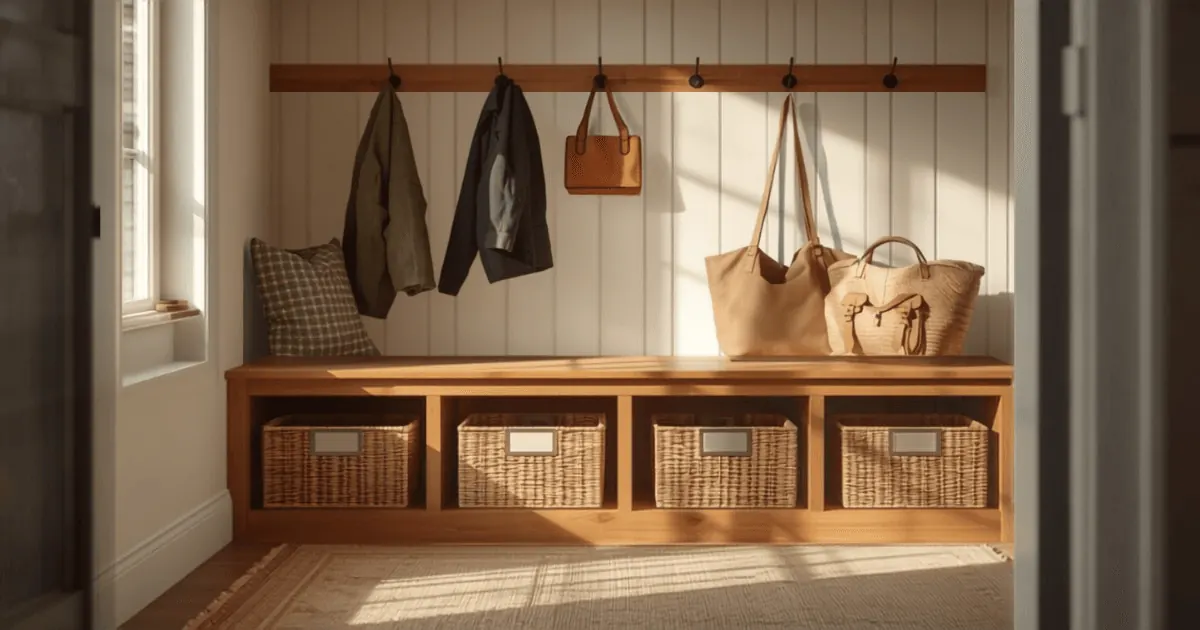
If you build nothing else in a mudroom, build the hook wall. A wall-mounted hook rail with multiple hooks per person is the single most functional piece of mudroom infrastructure. Every person in the household needs a minimum of two hooks: one for a bag or backpack, one for a coat or jacket. Three hooks per person is better if space allows, covering a coat, a bag, and a secondary layer like a hoodie or sports bag.
Height positioning matters. Adult hooks belong at standard coat-hook height, roughly 60 to 66 inches from the floor. Kids need their own row lower down, at around 42 to 48 inches, so they can hang and retrieve their own items independently. A two-row system, one adult height and one child height, handles mixed households without anyone needing to be lifted or helped every time.
Double-hook strips are more efficient than single hooks because they allow stacking without entanglement. A coat in front and a bag in back can coexist on a double hook without the items getting tangled together.
Compare Options
Compare Options
Compare Options
Shoe and Boot Storage
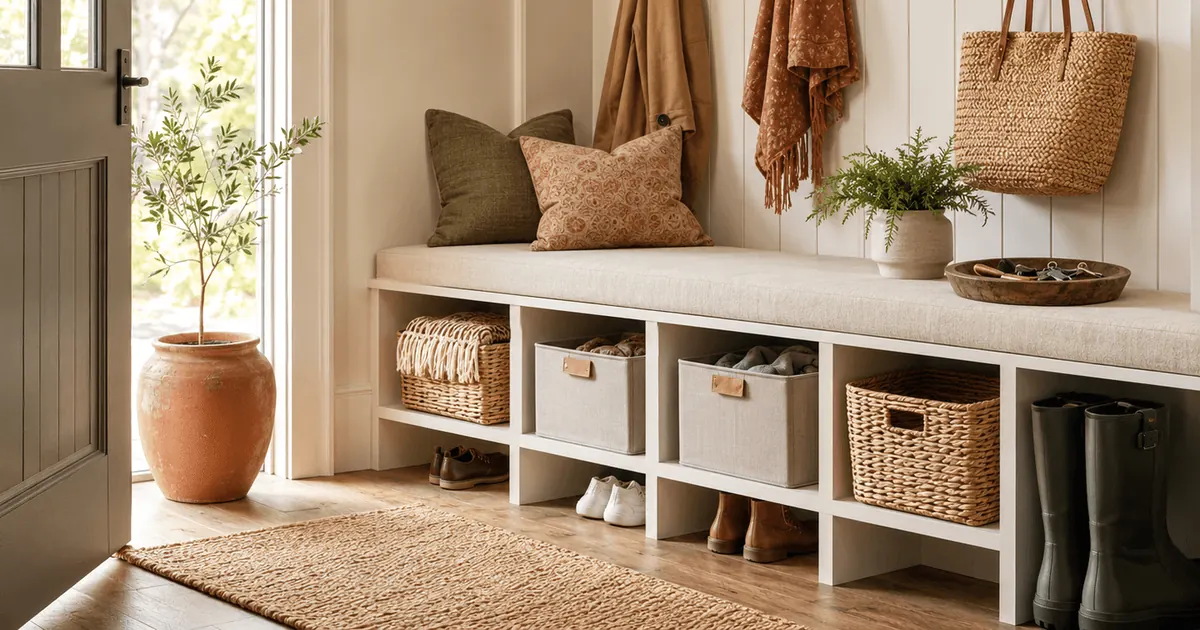
Open cubbies beat closed cabinets for everyday shoe storage. The reason is access speed. When someone comes in the door, they want to kick off shoes and put them somewhere in one motion. A cabinet that requires opening and closing a door creates friction that gets skipped, and shoes end up on the floor in front of the cabinet anyway.
A boot tray is essential for muddy or wet footwear. Place it directly inside the entry point. All wet shoes, muddy boots, and snow-covered footwear land on the tray. It contains the mess in one containable spot that can be wiped out or taken outside to dump.
A storage bench with cubbies underneath handles two functions at once. It gives people a place to sit while removing shoes and provides cubbies underneath for shoes that are not currently in use. This is particularly effective if the mudroom doubles as the primary seating area for putting on and removing footwear.
For overflow shoes beyond daily pairs, an over-door shoe organizer on the back of the mudroom door or a nearby closet door handles extras without adding floor footprint.
Compare Options
Compare Options
Bag and Backpack Organization
Assign hooks by person, not by item type. One hook for coats and a separate hook for bags is a two-hook system. One person with one coat and one backpack per hook is a different kind of system, and it is the one that actually prevents pile-ups.
When everyone has a designated hook location, the question is never "where does this go?" The answer is always "your hook." This removes decision fatigue from the daily routine, which means it actually happens instead of resulting in a pile on the floor.
Low hooks for kids are not optional. A hook at adult height that a child cannot easily reach independently will be skipped every single time. The child will drop the backpack on the floor and walk away. Mount a second lower hook at their reach height and the behavior changes.
Labeled hooks are useful in households with multiple kids to eliminate the "that is my hook" argument and reduce the shuffle that happens when one person takes another person's spot.
Compare Options
For backpacks, use a rail anchored into studs rather than adhesive hooks.
Key and Mail Command Center
Keys need one location at eye level near the door. This is not a storage question. It is a habit question. The hook has to be in the exact path of the entry routine, not across the room or around a corner. Mount it adjacent to the door, within two steps of entry, at eye level for the adults in the household.
A shallow wall pocket or tray next to the key hook captures mail, permission slips, bills, and papers that come in daily. The goal is to give incoming paper a place to land that is not the kitchen counter. Shallow trays work better than deep bins here because you can see what is in them without digging.
A small whiteboard or corkboard mounted near the command center serves as a communication hub for households with multiple people. Notes, reminders, and schedule updates stay visible to everyone passing through without requiring a separate check-in.
Compare Options
Compare Options
Choose a board narrow enough to leave the key and mail zones unobstructed.
Sports Gear and Seasonal Items
Sports gear needs one bin per activity. Not one bin for all sports gear. If baseball, soccer, and swim gear all go in the same bin, pulling out the baseball bag means moving the swim bag, which means the swim bag ends up on the floor, which means the system breaks in under a week.
Label each bin by activity and assign it a fixed shelf position. When a sport is in season, the bin moves to an accessible spot. Off-season, it moves to a higher shelf, to the garage, or to another storage area. Seasonal rotation is the key maintenance step that keeps the mudroom functional year-round.
Helmet hooks mounted at appropriate heights keep helmets off the floor and off shelves where they take up disproportionate space. A simple hook with a wide enough lip holds a bike helmet, baseball helmet, or ski helmet cleanly.
Dog leashes, pet leashes, and collars work best on a dedicated hook right next to the door, positioned at the height where they are grabbed on the way out. Keep this separate from the general hook wall so it does not get buried under coats.
Compare Options
Compare Options
A standard wall hook works for leashes when mounted beside the door at adult hand height.
Building a Mudroom Without a Mudroom
Most homes do not have a dedicated mudroom. Apartments, older homes, and condos often have nothing more than a front door opening directly into a living area. The same principles still apply, just compressed into a smaller footprint.
A hall tree is the all-in-one solution for entryways without dedicated space. Most hall trees combine hooks, a seat, and shoe storage underneath in a single freestanding piece that takes up roughly 18 to 24 inches of floor space. They are not as flexible as a built-in system, but they solve the core functions in a single purchase.
A floating shelf above a hook rail gives you a landing surface for mail, keys, and small items without needing a hall tree. Mount the shelf at a convenient height, install a hook rail below it, and add a small wall pocket for paper. This two-component system functions like a command center using only wall space.
Over-door systems on the back of the entry door add shoe storage, hooks, and pocket organizers without touching wall space or floor space.
Compare Options
Compare Options
Frequently Asked Questions
What is the most important mudroom storage piece?
A hook wall with enough hooks for every person and every item they carry is the single most important mudroom element. Without designated hooks, coats and bags end up on the floor, on furniture, or stacked on top of each other in a way that makes retrieval frustrating. Everything else, the bench, the shoe cubbies, the command center, builds on top of a functioning hook system. If you can only do one thing, build the hook wall.
How do you organize a small mudroom?
Go vertical. In a small mudroom, wall space is more valuable than floor space. Mount hooks, shelves, and wall pockets as high as usefully practical. Use a slim bench with cubbies rather than open floor storage. An over-door organizer on the mudroom door or nearby closet door adds capacity without using any wall or floor space. Keep the floor as clear as possible. A clear floor makes a small space feel more functional and makes cleaning easier.
What do you put in mudroom cubbies?
Shoes and boots in lower cubbies. Bags, hats, and gloves in upper cubbies. Bin inserts inside cubbies are useful for smaller items like hats and gloves that would otherwise get lost in a large cubby space. In family mudrooms, assign one cubby section per person. That way everyone has a dedicated zone and the whole system does not need to be reorganized when one person's items spill over.
How do you keep a mudroom from getting messy?
Every item needs a specific home, not a general area. A coat that belongs "on a hook somewhere" will end up wherever. A coat that belongs on the third hook from the left, which is your hook, has a destination. Specificity is what prevents mudrooms from reverting to chaos. Beyond that, do a 30-second reset every evening to return anything that drifted. The mudroom is small enough that a 30-second sweep is enough to maintain the system without making it a chore.
The Bottom Line
Mudroom organization works when it matches the actual behavior of the people using it. Build for how your household moves, not for how you wish it moved. Assign specific homes to specific items, make hooks accessible for everyone including kids, and the system will hold without constant maintenance.