We research, compare, and evaluate every product we recommend, and only describe a pick as directly tested when that is specifically documented. As an Amazon Associate I earn from qualifying purchases. When you buy through our links we may earn a commission -- at no extra cost to you. Full disclosure.
Before You Start: The Spring Declutter Protocol
You cannot organize clutter. That's the part most people skip, and it's why their organized spaces fill back up within a month. Before you buy a single bin or shelf divider, you need to reduce the total volume of stuff you're dealing with.
The protocol is a three-category sort: keep, donate, discard.
Work one zone at a time. Pull everything out of the space, put it on a flat surface, and make a decision on each item before it goes back in. The rule is no pile in the middle, no "I'll decide later" category. Every item gets a category before you move to the next one.
The one full year rule for clothes. If you haven't worn it in a full year, including through the season it was made for, it doesn't go back in the closet. This is not sentimental. A shirt you keep because you might wear it next summer is a shirt that takes up space every day while contributing nothing. The one-year mark is long enough to be fair and short enough to be honest.
The use it or lose it rule for kitchen gadgets. If you can't remember the last time you used it, you don't use it often enough to justify the drawer space. This covers the panini press, the mandoline you bought once for a party, the pasta roller attachment, and the citrus juicer that sits behind the blender. If it's not earning its shelf real estate, it doesn't stay.
How to actually finish a declutter instead of abandoning it midway. The most common failure mode is starting with the hardest category (sentimental items, old photos, inherited objects) and stalling there while the rest of the apartment stays untouched. Start with the easiest, most obvious stuff: expired food, broken items, duplicates, things you actively dislike. Build momentum before you get to anything that requires more than two seconds of thought. And stop before you're exhausted. A completed half-room beats an abandoned whole apartment every time.
Kitchen
The kitchen is usually the hardest room to organize because it serves multiple functions simultaneously: cooking, storage, cleaning, and in most apartments, at least some eating. The goal is to set up zones that match how you actually use the space, and then make it easy to return things to the right zone.
Pantry system. The default pantry arrangement in most homes is whatever fit when you put it away. Everything stacked in front of everything else, items you use daily buried behind things you bought once for a recipe. The fix is zoning by type and transferring to clear containers for anything you store long-term.
Zones: baking (flour, sugar, baking powder), grains and pasta, canned goods, snacks and grab-and-go, and condiments/oils if your pantry has the depth for it. Clear containers are not just aesthetic. They let you see what you have without pulling everything forward, and they make the expiration status of dry goods visible at a glance. Stackable square containers use space more efficiently than round ones.
Recommended: stackable airtight containers for pantry staples. An airtight seal, square shape, and one-handed lids matter most. The set should cover the most common sizes for flour, sugar, pasta, and grains. A set of adhesive chalk labels keeps everything readable without permanent marker on the container itself.
Under-sink organization. The under-sink cabinet is wasted in almost every rental. The plumbing takes up the center, which means the storage on either side goes unused or becomes a graveyard for cleaning products you forgot you owned. The fix that works for renters: two tension rods, installed side by side at whatever height clears your tallest bottles. Hang spray bottles from the rods by their trigger handles. Everything else gets a stackable bin on the base.
An under-sink tension rod organizer handles this in most standard-depth cabinets. No tools, no drilling, repositionable if your cabinet layout changes.
Junk drawer. Most junk drawers exist because there's no better place for the things that end up there: batteries, rubber bands, takeout menus, random charging cables, pens, and the manual for an appliance you don't own anymore. The right way to deal with it is not to eliminate it but to subdivide it. A shallow drawer organizer with compartments gives every category of small item a designated slot, which makes it possible to actually find things and to notice when something doesn't belong.
Use an adjustable drawer organizer with movable dividers. It works in most standard kitchen drawer depths and handles the main junk drawer categories without requiring you to pre-sort everything perfectly.
Closet
Closets fail when they're organized around what you have instead of how you dress. If you reorganize your closet to match your wardrobe right now, you'll need to reorganize it again in six months when the seasons change and your habits shift. The better approach is to build a system that accommodates rotation without requiring a full overhaul.
Seasonal rotation, done correctly. Rotating your wardrobe doesn't mean flipping everything twice a year. It means keeping what you wear regularly at the most accessible level (eye height, easiest reach), and moving everything else to secondary storage. In a single-rod closet, that might mean a shelf above the rod for off-season items in a vacuum storage bag. In a larger closet, it means pulling the back section for off-season and the front section for current use.
The rotation point is not January 1 and June 1. It's when you notice you're reaching over things you haven't touched in three weeks to get to the things you wear every day. That's when you rotate.
Shelf dividers. If your closet has open shelving, stacks of folded sweaters and jeans will lean and collapse without a divider. Shelf dividers clip to the existing shelf and create vertical separations that keep stacks upright and visible. Choose dividers that install in seconds on standard wire or wood shelves, no tools needed.
Slim velvet hangers. The single highest-leverage change in most closets is switching from plastic or wire hangers to slim velvet ones. A standard plastic hanger is about 20mm wide. A slim velvet hanger is 5mm. In a 36-inch rod, that's the difference between 35 items and roughly 140 before you hit the wire-on-wire compression that makes everything wrinkle. The velvet surface also keeps slippery fabrics from sliding to the floor.
Shoe storage. The right solution depends on how many pairs you have and how much floor space you're working with. For 10 to 20 pairs: a clear stackable shoe box system keeps pairs visible and dust-free. For more than 20 or limited floor space: an over-door shoe organizer handles everyday shoes without using floor footprint at all. Clear-front boxes let you see what's inside without opening them, which is the one feature that matters most when you're trying to find something in the morning.
Bathroom
Bathroom organization has a time pressure that other rooms don't: everything you pull out, you need to find quickly, often in low light, usually when you're already running late. The system has to be immediate and intuitive.
Under-sink. Same principle as the kitchen: most of the space is going unused because the plumbing pipes block the center. The tension rod trick works here too for cleaning products, but the more useful solution under a bathroom sink is a two-tier sliding organizer. It pulls out like a drawer, gives you access to items stored at the back, and sits on the cabinet floor without any installation. A compact two-tier unit fits most standard bathroom vanity cabinets and doubles usable storage without any modification to the cabinet.
Medicine cabinet: what to actually throw out. Most medicine cabinets contain a mix of things you use regularly, things you keep for emergencies, and things you forgot were there. Pull everything out and check expiration dates first. Expired medications need to go, not into the trash (water contamination risk) but through a pharmacy take-back program. Once you've removed the expired items and the duplicates, what's left should fit cleanly. If it doesn't, something else needs to be relocated.
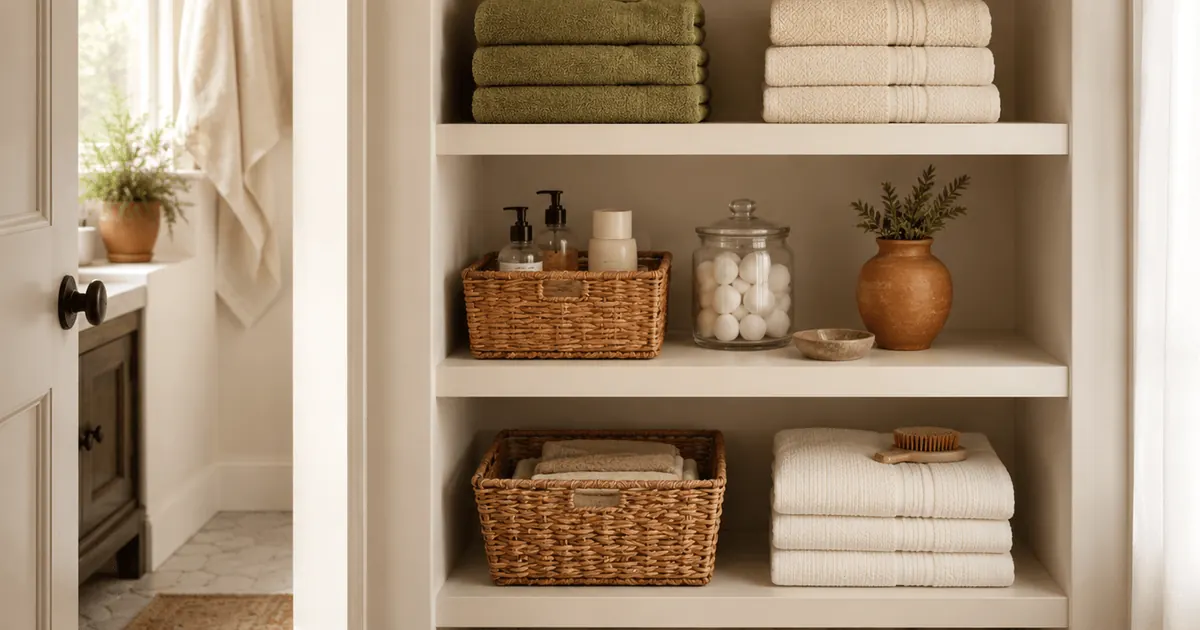
Linen closet. If you have one, the goal is to use the vertical space properly. Towels and sheets that are folded and stacked flat can go four or five high before they become unstable. The better approach for sheets is to fold the full set, including the fitted sheet and pillowcases, and store the whole set inside one pillowcase. It takes up less space, stays together, and you can pull a complete set without un-stacking everything. bathroom storage solutions
For extra toiletries and overflow items, a labeled bin on the top shelf keeps backup stock organized without mixing it in with everyday items.
Living Room and Common Areas
The living room accumulates clutter faster than any other space because it's where life actually happens. Remotes, chargers, books, mail, bags, keys, and everything else that doesn't have a more specific home tends to land here. The goal is to build legitimate homes for the things that actually land in this space, so the surface clutter has somewhere to go.
Cable management. The cluster of cables behind and under the TV or desk is one of the most common sources of low-grade visual noise in a home. The minimum effective fix is a cable box that hides the power strip and lets you run all visible cables into a single channel. It takes about ten minutes to set up, holds a standard power strip, and eliminates the cable pile without requiring you to thread anything through walls. For cables that run along a baseboard, adhesive cable clips keep the run tidy without permanent installation.
Baskets and bins. Visible storage is only useful if it stays easy to use. A basket that's attractive but inconvenient to access becomes decoration. Place baskets where the clutter already collects: next to the couch for blankets and remotes, near the door for bags and shoes, on the coffee table for items that belong in other rooms and need to make it there eventually. renter-friendly storage solutions
Entryway catch-all system. Entryways with a defined landing system keep the rest of the apartment cleaner because things stop migrating. The minimum system: hooks for bags and coats, a tray or bowl for keys and small items, and a narrow shelf or bin for shoes. In an apartment with no dedicated entryway, a wall-mounted hook rail next to the door and a shoe rack immediately inside the entrance creates the same function in roughly twelve inches of wall space.
Garage and Storage Room
Garages and storage rooms are where organization goes to die, because they don't have a social function. Nobody sees the garage, so nothing motivates you to keep it tidy. The only solution is a system that makes the right behavior easier than the wrong one.
Wall storage for renters. If you don't own the space and can't install permanent track systems, freestanding shelving is the answer. Heavy-duty wire shelving units on adjustable feet hold significant weight, require no wall attachment for standard loads, and can be repositioned or taken with you when you move. A unit against each wall converts a 10×10 garage from floor-pile territory to a genuinely organized space.
Seasonal item rotation. The principle here is the same as the closet: what you're using right now goes at the most accessible level. Summer gear goes to floor-level shelving in spring and summer. Winter gear goes to the top shelves where it can sit undisturbed for eight months. The rotation takes fifteen minutes twice a year if the bins are already labeled.
Labeled bins. The reason bins work in storage areas is not the bins. It's the labels. A bin without a label becomes a bin where you put things you're not sure about, and then a bin you can't open without sorting through it first. Every bin in a storage area needs a label visible from the front, at eye level or below, that tells you exactly what's inside. Use adhesive label tape for storage and garage areas where chalk labels won't survive humidity and temperature changes.
The categories that work for most households: Holiday (by holiday if you have the bin count), Tools, Camping/Outdoor, Sports Equipment, Off-Season Clothes, and Donate (a permanent donate bin makes it easier to act on declutter decisions in the moment, rather than letting items drift back into rotation).
The Maintenance System
The reason most organization projects fail is not the initial setup. The setup is usually fine. The failure is in what happens when life speeds up, when something gets put back in the wrong place, and then the wrong place becomes a pile, and then the pile is the new normal. The only way to prevent that is a maintenance routine that's short enough to actually happen.
The 15-minute weekly reset. Once a week, walk through each space and return things to where they belong. Not a deep clean. Not a reorganization. Just: does this item have a home, and is it there? Fifteen minutes handles this for most apartments if the system is working. If it takes longer, that's information: either the system has a friction point that needs to be fixed, or you've added items that don't have assigned homes yet.
Seasonal check-ins. Once per quarter, do a slightly longer review: fifteen to thirty minutes per zone. The questions are: Has my behavior changed in ways that make this layout less useful? Have I added items that are now living in temporary spots? Is anything expired, broken, or unused that should leave? This isn't a full reorganization. It's a calibration to keep the system matching your current life.
The one in, one out rule. Every time something new comes into the home, one thing leaves. This is the simplest way to maintain storage capacity over time without requiring periodic purges. It's also easier to execute in the moment than it is to apply retroactively after six months of accumulation. New kitchen gadget goes in, old one that's been sitting unused goes in the donate bin. New pair of shoes comes in, a pair you haven't worn this year goes out. The rule works because it keeps the math even.
Closing
Go back to where this started: cleaning is a session. Organizing is a system.
You can clean every week and still live in a cluttered space if the underlying arrangement doesn't match how you actually use the rooms. What this guide is trying to do is close that gap, room by room, with solutions that work in rentals, that don't require a big budget, and that hold up under normal life instead of requiring you to live carefully around them.
Set it up once. Maintain it with fifteen minutes a week. Revisit it quarterly. That's the whole system. Everything else is details.
storage ideas for small apartments and rentals
FAQ
How do I combine spring cleaning with home organization?
Treat them as two separate but sequential tasks within the same session: declutter and clean a space first, then organize what remains before moving on. Trying to organize while cleaning slows both processes down. Once a room is clean and cleared of everything that doesn't belong there, you have an accurate picture of what storage the space actually needs -- which makes organizing decisions faster and more permanent.
What organization projects are best to tackle during spring cleaning?
Closets, pantries, and the kitchen junk drawer are the highest-value targets because they accumulate disorder year-round and have the most immediate daily impact once organized. Linen closets and under-sink bathroom storage are close behind -- both are easy to complete in under an hour and stay organized well when given basic containers and labels. Save garage and basement organization for a dedicated session rather than tacking it onto a spring clean.
What products do I actually need for a spring cleaning and organization session?
All-purpose cleaner, microfiber cloths, a vacuum with attachments, and a mop cover the cleaning side for most homes. On the organization side, a set of uniform clear bins with lids, a label maker or masking tape and a marker, and a few drawer dividers handle the majority of projects without overbuying. Avoid purchasing containers before you've decluttered -- buy only after you know exactly what you're keeping and how much space it needs.