We research, compare, and evaluate every product we recommend, and only describe a pick as directly tested when that is specifically documented. As an Amazon Associate I earn from qualifying purchases. When you buy through our links we may earn a commission -- at no extra cost to you. Full disclosure.
3. Do not start in the hardest room.
Start in a small, easy room to build momentum. Closet under the stairs, half bath, junk drawer. Finish something in an hour. Then move up.
The 14-day schedule
Day 1: Junk drawer + one kitchen drawer
Day 2: Fridge + pantry
Day 3: Master closet
Day 4: Master bathroom
Day 5: Kids' rooms (pick one per child)
Day 6: Shared bathroom(s)
Day 7: Linen closet + under-sink bathroom storage
Day 8: Living room + entryway
Day 9: Office / desk / mail pile
Day 10: Laundry room + cleaning supply storage
Day 11: Garage zone one (tools and seasonal)
Day 12: Garage zone two (sports and outdoor gear)
Day 13: Attic or basement (one zone only)
Day 14: Reset and finishing pass
If you miss a day, you miss a day. Do not restart. Pick up on the next open day.
Day 1: Junk drawer and one kitchen drawer (30 minutes)
The smallest, fastest win. Dump the drawer on the counter. Sort into three piles:
-- Keep (use weekly)
-- Move (belongs somewhere else)
-- Trash
Throw out the trash pile. Put the "move" pile in a tote by the door to redistribute. Put the keep pile back with drawer dividers. Done.
Buy if needed: adjustable drawer dividers (~$15 for two drawers). Simple, no-slip, and they fit most kitchen drawers.
Day 2: Fridge and pantry (2 hours)
Fridge (45 min):
-- Empty everything
-- Trash anything past date
-- Trash condiments you have not used in 3 months
-- Wipe shelves with warm soapy water, dry
-- Return by zone: dairy up high, produce in drawers, sauces in door
Pantry (1 hour 15 min):
-- Empty all shelves
-- Trash expired, donate unopened non-expired you will not eat
-- Group by category: baking, breakfast, snacks, canned, pasta and rice
-- Return with the most-used items at eye level
-- Stale crackers, chips, cereal: trash now, not "later"
Buy if needed: airtight containers for flour, sugar, rice, pasta (~$30 to $60). Do not buy more than you will immediately fill.
Day 3: Master closet (3 to 5 hours)
This is the hardest day. Block the time.
Method:
1. Pull everything out. Dump on the bed.
2. Sort into four piles: keep, donate, tailor, toss
3. The rule: if you have not worn it in a year and it is not special-occasion, donate
4. Shoes: if they hurt, donate. Life is too short.
5. Hang everything you are keeping back by category (tops, pants, dresses, outerwear) and within category by color
6. Fold sweaters, jeans, tees in one pile per type
Buy if needed: slim velvet hangers for a uniform look that stops sliding (~$40 to $80 for a full closet), plus seasonal storage bags (~$25 to $40).
Do not buy: Closet "systems" from a big box store until you have measured the space after decluttering. Measure twice. Buy once. Preferably in week 3.
Day 4: Master bathroom (1.5 to 2 hours)
- Medicine cabinet: trash anything past expiration. Prescription meds: take to pharmacy for disposal
- Drawers: dump, sort, wipe, replace with dividers
- Under sink: dump, sort, wipe, replace with a 2-tier riser or pull-out drawer
- Counter: clear everything off. Only return what you use daily
- Shower: replace old razors, trash half-used shampoos from three haircuts ago
Buy if needed: drawer dividers, a two-tier under-sink organizer, and a small counter tray to corral daily items. Budget about $30 to $50 total.
Day 5: Kids' rooms (2 to 4 hours per room)
If kids are old enough, do it with them. Give them three bags: keep, donate, trash.
Toy rule: If they have not played with it in 3 months, it goes. Exception: heirloom or sentimental.
Clothes: Anything outgrown goes today. If you have a younger kid or friend who wants them, set aside. Otherwise donate.
Books: Donate duplicates and books they have outgrown. Keep the ones they love.
Buy if needed: toy storage bins, one per category (blocks, cars, art supplies, Legos). Add labels. Budget about $40 to $70 per kid.
Day 6: Shared bathroom(s) (1 hour)
Faster than master because fewer products per person.
Same method: medicine cabinet, drawers, under sink, counter, shower. Trash anything expired or not used in 3 months.
Family pro tip: Assign each person a colored bin or drawer for their daily products. Eliminates the "whose is this" pile.
Day 7: Linen closet and under-sink bathroom storage (1.5 hours)
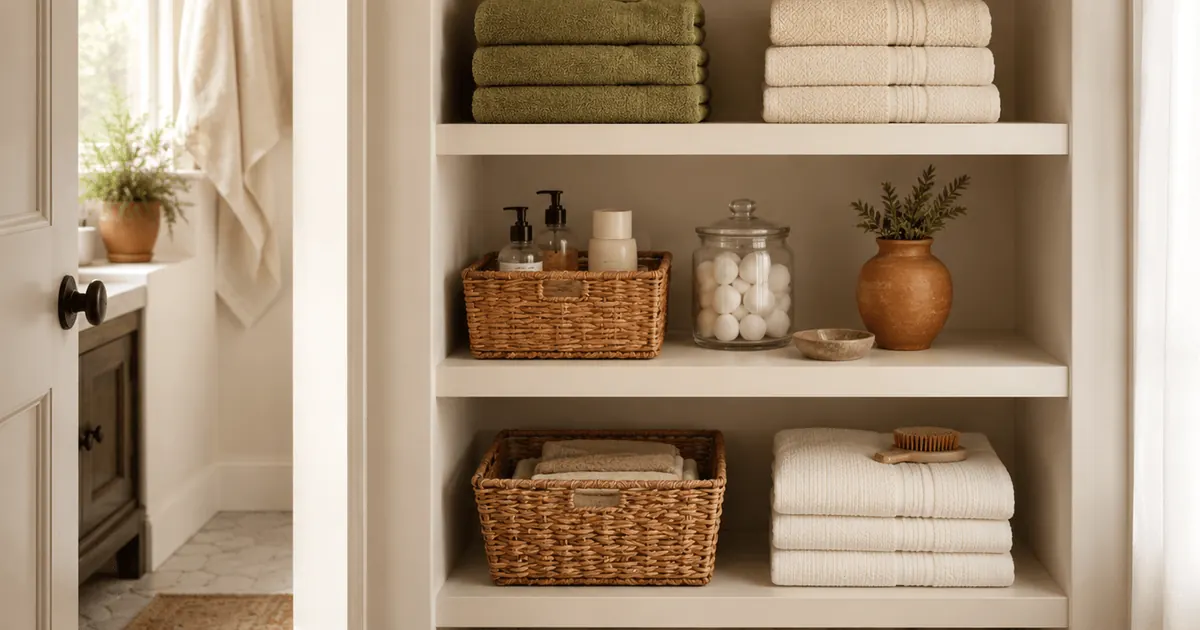
Linen closet:
-- Trash or rag-pile any towels past their prime
-- Rule: 2 sets of sheets per bed + 1 spare set total per house
-- Fold standard: fitted, flat, pillowcase folded into one pillowcase = one set, one slot
-- Label shelves (king, queen, twin, bath, hand, washcloths)
Under sink:
Same method as Day 6.
Day 8: Living room and entryway (2 hours)
Living room:
-- Clear all surfaces completely
-- Wipe, dust, vacuum
-- Return only what you want to see (books, remotes, one decorative piece, maybe a candle)
-- Everything else goes back to where it belongs
Entryway:
-- One hook per person for bags or coats
-- One bin or basket for shoes (per person or shared)
-- One tray for keys and mail
-- Nothing else. No "miscellaneous." Do not make a miscellaneous pile.
Buy if needed: an entryway storage bench and hooks (~$60 to $150). Keeps shoes, bags, and keys off the floor.
Day 9: Office / desk / mail pile (1 to 3 hours)
The mail pile:
-- Shred anything with personal info from before 2024
-- Keep tax documents for 7 years (store in a labeled box)
-- Bills: most are digital now, toss paper copies
-- Rule: if it has not been touched in 6 months, it is not urgent. Shred or file.
The desk:
-- Pens: test each, trash the dried ones
-- Paperclips, rubber bands, sticky notes: consolidate
-- Wires: untangle, label with painter's tape
-- Hardware (USB, cables, chargers): one bin. Label. Done.
Buy if needed: hanging folders or a 3-tier paper tray (~$20 to $50).
Day 10: Laundry room and cleaning supply storage (1 hour)
- Consolidate laundry products: one detergent, one stain remover, one bleach. Do not keep five half-empty detergents.
- Cleaning supplies: same rule. One glass cleaner, one all-purpose, one bathroom cleaner, one floor cleaner. Everything else duplicate, combine or toss.
- Trash rags past their prime
- Wipe the inside of the washer gasket (you will thank me)
Buy if needed: a laundry shelf organizer and one laundry detergent dispenser if you buy in bulk (~$30 total).
Divide the garage into two zones mentally. Do one today.
Tools and seasonal:
-- Tools: wall organizer or pegboard. Group by type (hammers, wrenches, drills)
-- Seasonal (Christmas, Halloween, etc.): label bins clearly, stack by when they come out
-- Paint cans: trash any open paint over 2 years old. Half-empty paint in metal cans goes bad.
Buy if needed: a garage wall organizer for tools and clear labeled bins for seasonal gear. Budget about $80 to $200 total.
Day 12: Garage zone two (sports and outdoor gear) (2 hours)
Sports and outdoor:
-- Dump everything out
-- Trash anything broken, outgrown, or forgotten
-- Bikes: hang them on wall hooks if you can (clears floor)
-- Pool/beach gear: consolidate into one bin
-- Camping: consolidate into one clear labeled bin per category (cooking, sleeping, shelter)
Buy if needed: bike wall hooks and outdoor gear hooks (~$40 to $80). Clears the floor and protects the frames.
Day 13: Attic or basement (one zone only) (2 to 4 hours)
Do not try to do the whole attic or basement. Pick one zone. Maybe the box wall by the stairs. Maybe the seasonal decor corner.
Apply the same method: dump, sort, trash or donate, label bins clearly, stack with the most-used on top.
The rule for attic and basement: If you do not know what is in a box without opening it, and you have not opened it in 2 years, you probably do not need what is in it. If you cannot throw the whole box away unopened, at least promise to sort it next year.
Day 14: Reset and finishing pass (2 hours)
Walk the whole house.
- Take out the donation pile and drive it to Goodwill today
- Break down any boxes
- Trash any "I will deal with later" piles
- Wipe any surfaces that got missed
- Put fresh sheets on the bed
- Run the vacuum through the whole main floor
- Light a candle
Done.
Weekend-only plan (if you do not have 14 days)
Saturday morning: Master closet + master bathroom (5 hours with breaks)
Saturday afternoon: Kitchen (pantry, fridge, junk drawer) (2 hours)
Sunday morning: One kid's room or entryway + living room (3 hours)
Sunday afternoon: Garage zone one OR mail pile OR linen closet (2 hours)
Sunday evening: Donation run and reset (1 hour)
What to donate vs throw away
Donate (Goodwill, a local shelter, Buy Nothing group):
-- Clothes in clean, wearable condition
-- Shoes in clean, wearable condition
-- Kitchenware in good condition
-- Books
-- Working small appliances (coffee makers, toasters)
-- Furniture in usable condition
Throw away or recycle (Goodwill does not want):
-- Anything broken, stained, ripped, or moldy
-- Old mattresses (check your city's bulk pickup)
-- Expired food
-- Expired medications (take to pharmacy)
-- Worn-out towels and sheets (rag pile or animal shelter donation)
Do not do this: Give Goodwill stained clothes and "let them decide." They will throw them out and you created a landfill detour. Just throw it out.
Buy list (full guide)
If you want to do the whole plan, the one-time buy list is approximately:
- Adjustable drawer dividers: ~$30
- Airtight pantry containers: ~$50
- Slim velvet hangers: ~$60
- Seasonal clothing storage bags: ~$30
- Two-tier bathroom under-sink organizer: ~$50
- Kids toy storage bins: ~$60 per kid
- Desktop file organizer: ~$30
- Laundry room shelf organizer: ~$30
- Garage tool wall organizer + garage storage bins: ~$150
- Entryway storage bench (optional): ~$100
- Garage bike wall hooks: ~$60
Total baseline: $550 to $750 for a full house reset.
Start smaller: If you only buy for the rooms you actually do, you will spend $200 to $400. Do not over-buy.
- A "one in, one out" rule for clothes and toys
- A 10-minute nightly tidy (just a quick pickup, not cleaning)
- One day per month for a small reset (one drawer, one shelf)
- Seasonal donation runs (every 3 months, a bag out the door)
- Label everything; future you does not remember what is in the unlabeled bin
What does NOT work (skip the trendy stuff)
- "Konmari-ing" the whole house in one weekend. You will burn out by 2pm Saturday.
- Buying a $400 closet system for a closet you have not decluttered yet.
- Color-coded bins with no labels. You will forget what goes where by October.
- Aesthetic containers for hidden storage (under-bed, attic, basement). Save the money. Buy clear labeled plastic.
- Wire shelving that sags. Spend $20 more for something rigid.
Spring cleaning is not a one-weekend heroic effort. It is fourteen small wins, ordered right, with momentum you build from day one.
Garage Organization Ideas That Actually Last
Pantry Organization on a $100 Budget
Closet Systems Compared
See also: Sterilite vs IRIS vs Rubbermaid Storage Bins: Which Brand Wins in 2026?
FAQ
What is the best order for spring cleaning a house?
Start with decluttering before you clean -- cleaning around clutter wastes time and motivation. Work top to bottom and room to room: start with bedrooms and closets, move through common areas, and finish with the kitchen and bathrooms last since those require the most scrubbing. Tackle one room completely before moving to the next so you get visible wins early that keep the momentum going.
How long does a thorough spring cleaning take?
A full house spring clean typically takes two to four days spread across two weekends if you're working alone on an average-sized home. Trying to compress it into a single weekend usually leads to burnout and half-finished rooms. Breaking it into 14 focused sessions of one to two hours each -- one area per session -- is more realistic and produces better results than marathon all-day pushes.
What should I declutter first when spring cleaning?
Start with the easiest, lowest-stakes categories: expired pantry items, duplicate kitchen tools, and clothing you haven't worn in over a year. Quick wins in these categories build decision-making momentum before you reach harder items like sentimental objects or paperwork. Save whole-room overhauls for after you've already cleared several obvious categories and the process feels manageable.