We research, compare, and evaluate every product we recommend, and only describe a pick as directly tested when that is specifically documented. As an Amazon Associate I earn from qualifying purchases. When you buy through our links we may earn a commission -- at no extra cost to you. Full disclosure.
The reason a kids room never stays tidy is rarely the amount of stuff. It is that the storage was designed for adults. A deep toy box buries everything at the bottom, a high shelf is out of reach, and a bin with a heavy lid is one more obstacle between a four-year-old and putting a toy away. The bins that actually keep a kids room organized are the ones a child can open, fill, and carry without help.
This guide covers the eight best storage bins for kids rooms in 2026, chosen for the realities of how children actually use them: open access, light weight, clear or labeled fronts, and durability that survives daily dumping. Each pick explains what it is, why it works for kids, and who it suits. Every pick is evaluated Research-Backed and Spec Checked against published specifications and aggregated owner feedback; we do not make first-hand product testing claims. Prices change, so treat figures as ranges and confirm at the link.
If you want one purchase that organizes most of a kids room, a multi-bin toy organizer is it. The Humble Crew frame holds a grid of removable, tilted bins at child height, so kids can see into each bin and pull it out, sort, and slot it back. The tilt is the key detail: it lets a child view contents without lifting anything off a shelf.
The variety of bin sizes lets you zone by category, big bins for stuffed animals and blocks, small bins for cars and figures, which teaches sorting and makes cleanup a game of matching toys to bins. Because each bin lifts out, a child can carry one bin to the play area and bring it back, rather than dragging out a whole toy box. It is the backbone most kids rooms are missing.
Best for: Organizing most of a kids room in one purchase, with bins sized for sorting by category.
Pros: Child-height tilted bins show contents, removable bins for carry-and-return, mixed sizes for sorting, sturdy frame.
Cons: Frame needs assembly; takes more floor space than a single bin.
2. Fabric Storage Cube Bins with Labels (Set of 6) - Best for Cube Shelves
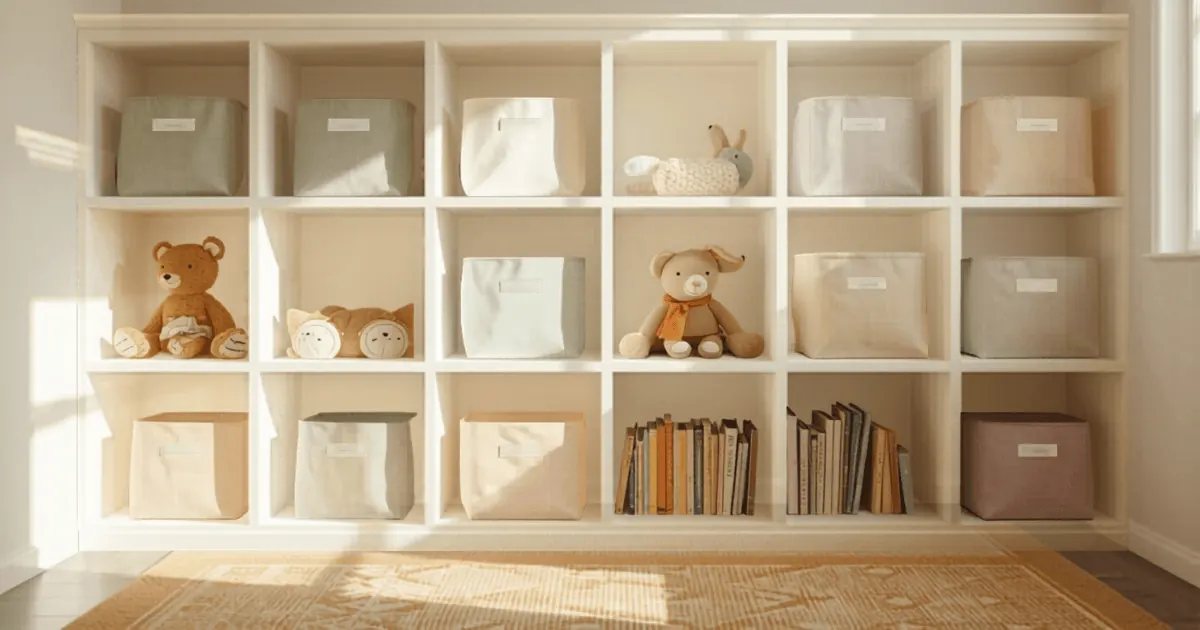
Cube shelving is the most common storage furniture in kids rooms, and fabric cube bins are what make it work. The soft sides are gentle when a child shoves a bin in, the reinforced base keeps the bin square when filled, and the label slots let you mark each cube so a pre-reader can match a picture to a category.
Fabric cubes give a kids room a calmer, less plastic look while still hiding the mess inside. They suit clothing, soft toys, art supplies, and books, and they fold flat when empty for an easy off-season swap. A set of six fills a standard cube unit, instantly turning open cubbies into tidy labeled storage.
Best for: Cube and cubby shelving, with a soft look and labels pre-readers can match.
Pros: Fits standard cube shelves, soft on kids and furniture, label slots aid pre-readers, fold flat when empty.
Cons: Less protective than rigid bins; fabric can sag if badly overfilled.
3. Clear Plastic Stackable Storage Bins with Lids - Best for Sorting Small Toys
Small toys with many pieces, building bricks, dolls and their accessories, craft beads, are the hardest to keep together. Clear stackable bins with lids solve this because a child can see exactly which bin holds which set without opening anything, and the lid keeps the pieces from scattering. The stackability means a whole collection lives in a neat tower instead of a sprawl.
Clear walls do the labeling for you with young kids who recognize the toy faster than the word. Use one bin per set or category so cleanup is just matching pieces to the right clear box. The lids also let you stack seasonal or rotated toys up high and out of the daily mix.
Best for: Sorting small multi-piece toy sets and sealing rotated or seasonal toys.
Pros: Clear walls show contents, lids contain small pieces, stack into neat towers, good for toy rotation.
Cons: Lids add a step for the youngest kids; rigid corners are harder than fabric.
Compare Options
4. Rolling Storage Bin with Wheels - Best for Heavy Loads
A bin full of blocks or trucks is heavy, and a young child who cannot lift it will simply leave it where it lies. A rolling bin fixes that by letting a child push or pull a heavy load across the room on wheels, which means they can actually move toys to and from the play area independently.
Wheeled bins are ideal for the bulkiest, heaviest toy categories and for rooms where toys migrate between a bedroom and a playroom. Look for a sturdy bin with locking or recessed wheels so it does not roll away during play. It is the pick that turns cleanup from a job an adult does into one a child can manage.
Best for: Heavy toy categories and rooms where toys travel, so kids can move loads themselves.
Pros: Wheels let kids move heavy loads, supports independent cleanup, great for blocks and trucks, easy to roll under play tables.
Cons: Wheels can roll during play unless lockable; takes floor space.
Compare Options
5. Collapsible Fabric Storage Bins (Set of 4) - Best for Quick Cleanup
Sometimes the best bin is a big, soft, open one you can sweep an armful of toys into fast. Collapsible fabric bins with sturdy handles make the nightly five-minute cleanup realistic: open the bin, scoop, done. The open top means no lid stands between a tired child and putting things away.
Because they collapse flat, these are also the easiest bins to store off-season or pack for a trip to grandma's. Set of four gives you a big general bin in each play zone, plus a spare. They are not for fine sorting, but as the catch-all that makes daily tidying happen, they earn their spot.
Best for: Fast daily cleanup with big open catch-all bins kids can fill quickly.
Pros: Open top for fast scooping, sturdy handles for carrying, collapse flat for storage, soft and lightweight.
Cons: No lids or sorting; open bins look fuller and messier than lidded ones.
Compare Options
6. Front-Facing Book Display Bins - Best for Books
Picture books are impossible to browse on a normal shelf, because little kids cannot read tiny spines and will pull ten books out to find one. A front-facing book bin displays covers outward so a child can see and choose a book the way they do at the library, which makes them far more likely to read and to put books back.
These bins keep books upright and reachable at child height instead of stacked in a slumping pile. Sort by favorites in the front bin and rotate the rest, and reading corners stay inviting rather than chaotic. For any room with more than a handful of picture books, a display bin changes how the books get used.
Best for: Picture books and reading corners where kids choose by cover, not spine.
Pros: Covers face out for easy browsing, keeps books upright, child height, encourages reading and reshelving.
Cons: Holds fewer books than a shelf; not for chapter books with thin spines.
Compare Options
7. Large Lidded Storage Tote - Best for Bulky and Seasonal Toys
Some toys are too big or too rarely used for the daily bins, and bulky outdoor gear, holiday toys, or last year's playset belong in a large lidded tote that seals and stacks. A deep tote with a secure recessed lid stores tall and bulky items, slides under a bed, and stacks in a closet without tipping.
This is the bin that keeps the daily storage from overflowing, by giving the overflow a clean home. Rotate toys in and out of the active room from the tote to keep the everyday selection manageable and the room less crowded. Label it so the contents are findable months later.
Best for: Bulky toys and seasonal or rotated items stored under the bed or in a closet.
Pros: Deep sealed capacity, recessed lid stacks securely, slides under beds, protects rarely-used items.
Cons: Too big and heavy for daily child use; reserve for overflow and storage.
8. Small Open Bins for Shelves and Closet - Best for Fine Sorting
For the small stuff, cars, figures, craft supplies, hair accessories, a set of small open bins lets you sort by type on a shelf or closet. The open front means a child grabs the whole category at once, and grouping like with like is what stops the floor from becoming an undifferentiated pile.
Small open bins are the detail layer that makes a big-bin system actually work, because they prevent the everything-in-one-bin chaos that defeats organization. Line them along a shelf or inside a closet cube, one category each, and label the front. They are inexpensive enough to buy several and adjust as the collection changes.
Best for: Sorting small items by type on shelves and inside closets.
Pros: Open-front grab access, group by category, inexpensive to buy several, easy to relabel and rearrange.
Cons: Open tops gather dust; small bins alone will not hold bulky toys.
How to Choose Storage Bins for a Kids Room: The Method
Buy for the Child's Reach and Strength
The best bin is one your child can use without you. Keep daily bins at child height, choose open or light-lid designs for the youngest kids, and add wheels for heavy loads. If a bin is too high, too heavy, or too hard to open, it will get ignored and the toys will end up on the floor.
Sort by Category, Not by Toy
Group bins by type, blocks, cars, art, soft toys, rather than trying to give every toy its own spot. Categories are easy for a child to understand and make cleanup a sorting game. Clear walls or picture labels let pre-readers match toys to the right bin.
Layer Big Bins With Small Ones
Use a few large catch-all bins for fast daily cleanup and small open bins for fine sorting. The big bins make tidying realistic; the small bins keep the contents from becoming one giant jumble. Most rooms need both layers, not one or the other.
Plan for Rotation
Keep the daily selection small and store the rest in a lidded tote, rotating toys in and out. A room with fewer active toys is easier for a child to keep tidy, and rotation makes old toys feel new again when they reappear.
Frequently Asked Questions
What kind of storage bins work best in a kids room?
Open or light-lidded bins at child height work best, because a child can use them without help. A multi-bin toy organizer covers most of a room, fabric cubes suit cube shelves, and small open bins handle fine sorting. Add wheels for heavy loads and a lidded tote for overflow.
Should kids storage bins have lids?
It depends on the use. Daily-access bins are easier for young kids without lids, so cleanup has no extra step. Use lidded bins for small multi-piece sets that scatter and for seasonal or rotated toys you stack and store. Many rooms use a mix of both.
How do I get kids to actually put toys away?
Make the system match their abilities: bins they can reach, open or easy to open, and labeled with pictures so pre-readers know where things go. Sort by simple categories, keep the daily toy count manageable, and turn cleanup into a matching game. The easier the bin, the more likely the toy goes back.
How many storage bins does a kids room need?
Most rooms do well with one multi-bin organizer or cube unit, two or three large catch-all bins for fast cleanup, a handful of small bins for sorting, and one lidded tote for overflow. Start there and adjust as you see which categories overflow.
The Bottom Line
The bins that keep a kids room tidy are the ones built around the child, not the adult. Anchor the room with a Humble Crew multi-bin organizer or fabric cube bins for cube shelving, add clear lidded bins for small toy sets, a rolling bin for heavy loads, and collapsible bins for fast daily cleanup. Use front-facing book bins for picture books, a lidded tote for overflow, and small open bins for fine sorting.
For the bigger picture on a kids room, see our guides on best toy storage and playroom organization, best kids closet organizers, how to organize a kids room, and our roundup of the best stackable storage bins.