We research, compare, and evaluate every product we recommend, and only describe a pick as directly tested when that is specifically documented. As an Amazon Associate I earn from qualifying purchases. When you buy through our links we may earn a commission -- at no extra cost to you. Full disclosure.
Your entryway is the gateway to your home, and often the first impression guests receive. Yet for many households, the mudroom or entryway area becomes a dumping ground for coats, shoes, bags, and the day's detritus. When square footage is limited, mudroom organization for small entryways becomes not just a nice-to-have, but a practical necessity for maintaining order and functionality. The challenge is transforming a cramped space into an efficient, welcoming entry zone without overwhelming the area with bulky storage units.
The good news is that strategic mudroom organization doesn't require a renovation or a room expansion. With thoughtful planning, vertical storage solutions, and multi-functional pieces, even the tiniest entryway can become an organized hub where everything has its place. This comprehensive guide walks you through proven strategies, practical solutions, and product recommendations to help you reclaim your small entryway space.
Understanding Your Small Entryway: Assessment and Planning
Before you purchase a single storage item, take time to honestly assess your current space and storage needs. Measure your entryway carefully--not just wall-to-wall distance, but consider doorways, light switches, and how doors swing open. A piece that's technically "small" can feel massive if it blocks a door's swing radius or creates a navigation bottleneck.
Next, inventory what actually needs to live in your entryway. Most households require storage for:
- Coats, jackets, and seasonal outerwear
- Shoes and boots
- Bags, backpacks, and purses
- Hats, gloves, and scarves
- Umbrellas and rain gear
- Keys, mail, and small household items
- Occasionally, sports equipment or pet supplies
Be realistic about seasonal items. Winter coats don't need prime real estate in July. Identifying your core year-round items versus seasonal overflow helps you allocate space more efficiently. Also consider traffic patterns--who uses the entryway, how often, and at what times of day? A family of four has vastly different needs than a single person in an apartment.
Maximize Vertical Space: The Key to Small Mudroom Organization
In any small entryway, vertical space is your greatest asset. Walls from floor to ceiling represent untapped storage potential that doesn't require additional square footage. Rather than spreading storage horizontally across the floor, directing your organization strategy upward transforms even the tightest corner into a functional space.
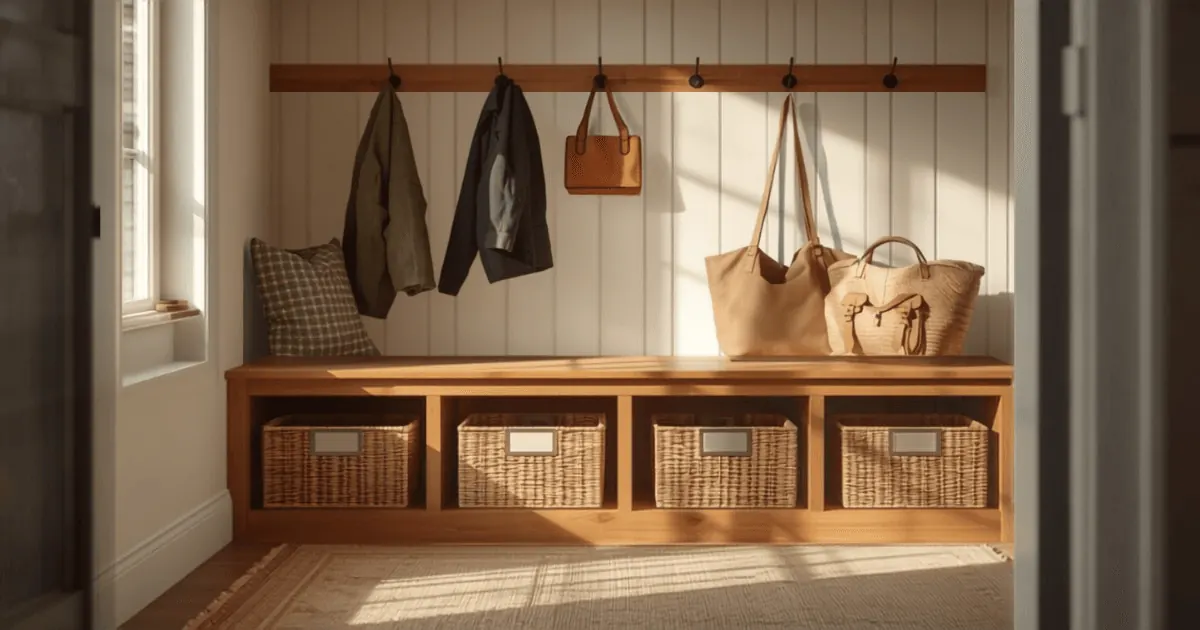
Wall-mounted hooks are the workhorse of small mudroom organization. They're inexpensive, incredibly versatile, and infinitely customizable. Install hooks at varying heights to accommodate coats for adults and children. Consider specialized hooks designed for specific items--over-door hooks for bags, adhesive hooks for small items on narrow walls, or sturdy wall hooks rated for heavier winter coats. Arrange hooks in a logical sequence based on how family members move through the space.
Floating shelves add visual interest while providing crucial storage for items that shouldn't hang. Baskets on shelves contain smaller items like gloves, scarves, and accessories, maintaining an organized appearance while maximizing capacity. A single shelf positioned at eye level can hold a dozen small bins and prevent visual clutter.
Over-the-door organizers are game-changers for minute entryways. The back of a closet door, bathroom door, or even the main entry door itself can hold shoe racks, hanging pockets for accessories, or narrow shelving. This solution works particularly well for apartments or rentals where wall modification isn't possible.
Corner spaces, often overlooked in small rooms, deserve attention. A corner shelf unit or a tall, narrow storage tower designed for corners maximizes an area that typically goes unused. These pieces fit snugly into awkward angles and provide surprising storage capacity without eating into your central floor space.
Choose Multi-Functional Furniture for Compact Spaces
In a small entryway, every piece of furniture should earn its place through dual or triple functionality. A storage bench with built-in compartments serves as seating while concealing shoes, boots, or seasonal items inside. Look for benches with lift-up lids or pull-out drawers. Some models include hooks on the back or sides, creating a complete entryway station in a single compact piece.
Entryway consoles with shelving below provide a landing spot for mail, keys, and everyday essentials while offering shelf space for baskets and additional storage. The surface area keeps items visible and accessible rather than hidden away, making it perfect for things you need to grab on your way out.
Coat racks that incorporate cubbies or shelves represent another efficient option. Rather than a simple vertical pole, these hybrid pieces combine hanging space with compartmentalized shelving. Measure the unit's depth and door-swing clearance before buying.
A tall, narrow cabinet designed specifically for entryways can hide clutter while maintaining a streamlined appearance. Choose one with drawers for small items and a closet rod or hooks inside for hanging coats. Closed storage visually expands small spaces by reducing visual clutter, making the entryway feel less cramped.
Organization Systems: Zones and Categories
Creating an organizational system ensures that your small mudroom stays functional long-term. Zone-based organization divides your entryway into logical areas, each serving a specific purpose. A "daily grab" zone near the door holds items needed for immediate departure--keys, phone, wallet, and bags. An "outerwear zone" focuses on coats and jackets. A "footwear station" concentrates all shoes and boots, and a "seasonal zone" stores items used only during specific times of year.
Within each zone, apply categorical thinking. Group similar items together: all winter accessories in one basket, all shoes in one designated area, all bags on one set of hooks. This system makes finding items intuitive and helps family members replace items in correct locations. Label your storage--especially baskets and bins--so everyone understands the system. Clear labels reduce friction and increase compliance, particularly with children and partners who might not intuitively know where things belong.
Create a "drop zone" for daily pocket contents. A small decorative tray, wall-mounted mail organizer, or a series of hooks with baskets below gives coats, bags, and keys a designated resting place before they migrate deeper into your home. This single habit prevents your entryway from becoming a catch-all for miscellaneous items.
Shoe Storage Solutions for Limited Space
Shoes often consume disproportionate space in small entryways. Rather than accepting this, implement strategic shoe storage that maximizes capacity while keeping your entryway visually organized.
Over-the-door shoe organizers work beautifully in compact entryways. Clear pockets let family members see shoe options at a glance, and the organization happens vertically rather than consuming floor space. Some households use multiple organizers on different doors or walls to expand capacity.
Shallow shelves designed specifically for shoes allow you to stack pairs vertically rather than horizontally, roughly doubling usable shelf space. Adjustable shelving gives you flexibility to adapt spacing as seasons change.
Shoe racks that sit on the floor should be narrow and tall rather than wide and sprawling. A slim, vertical shoe rack fits into corners and tight spaces while holding twelve to twenty pairs depending on design. Compare Options to explore compact shoe storage options.
For regularly-worn shoes, keep them accessible. Reserve deep storage for seasonal or special-occasion footwear. Create a "rotation system" where current-season shoes stay in your entryway's primary shoe zone, while off-season pairs move to closets or under-bed storage elsewhere in your home.
Baskets and Bins: Containing Chaos with Style
Baskets and bins serve as the foundation of functional small-space organization. They contain loose items, reduce visual clutter, and allow you to move grouped items as a unit if space needs to be reconfigured.
Choose baskets sized to your shelving--not so large that they don't fit properly, not so small that they waste valuable shelf real estate. Woven seagrass baskets add warmth and texture while containing items attractively. Wire baskets offer an industrial aesthetic and allow you to see contents at a glance.
Labeling your baskets is essential, especially when family members of different ages use the space. A label maker and some weatherproof labels transform your storage from chaotic-looking to deliberately organized. Categories might include: "Winter Accessories," "Gloves & Mittens," "Sunglasses & Hats," "Scarves," or "Backpacks & Bags."
For frequently accessed items like gloves or scarves, consider clear storage boxes so contents remain visible without opening them. For less-frequently-used items, opaque baskets reduce visual clutter. Measure the shelf opening before choosing basket sizes.
Hooks, Pegs, and Hanging Solutions
Hooks represent the most efficient use of entryway space. They're inexpensive, removable (important for renters), and accommodate items of vastly different weights and sizes. Strategic hook placement determines whether your entryway feels organized or chaotic.
Install hooks at multiple heights--high for adult coats, mid-level for family members, and lower for children's items. Spacing matters too; hooks placed three to four feet apart allow you to hang multiple items per person without them becoming tangled. Some families assign each person a specific color hook or section, making it immediately clear whose coat belongs where.
Over-the-door hooks multiply your hanging capacity without wall modification. They work on closet doors, bathroom doors, or even the main entry door itself. These accept anything a wall hook does--coats, bags, umbrellas, even scarves hanging from clips.
Pegboard systems provide modular flexibility that other solutions can't match. You can rearrange hooks as your needs change, add shelves for mixed storage, and create a customized solution that adapts as your family's requirements evolve. Compare Options.
Specialized hooks deserve consideration based on your specific needs. Adhesive hooks work on painted walls and doors without drilling. Heavy-duty hooks rated for multiple coats provide safety. Boot hooks with metal hooks on chains hang wet or muddy boots off flooring, preventing mess and promoting drying.
Seasonal Rotation and Long-Term Maintenance
Small entryways demand intentional seasonal rotation. As seasons change, swap out hanging storage contents. Winter coats migrate into storage as spring arrives, making space for lighter jackets. Heavy boots move out; lighter shoes move in.
Assign a secondary storage location elsewhere in your home for off-season items. A hall closet, bedroom shelf, or under-bed storage keeps seasonal gear accessible without consuming precious entryway real estate year-round. Vacuum-seal bags compress bulky winter coats, maximizing storage efficiency in your backup location.
Establish a regular maintenance schedule--monthly seems reasonable for most households. Spend fifteen minutes returning items to proper locations, removing items that no longer belong in the entryway, and reassessing whether your current system still works for your household's needs.
Spring and fall transitions present opportunities to evaluate your system. Did everyone have sufficient hook space? Were baskets properly sized? Did any storage solutions prove awkward or underutilized? Use these insights to refine your approach, perhaps repositioning items, upsizing certain storage zones, or introducing new organizational tools.
Design Considerations: Making Your Entryway Feel Intentional
An organized mudroom should feel welcoming, not institutional. Thoughtful design choices transform functional storage into an entryway that reflects your home's aesthetic.
Color coordination makes a significant difference in small spaces. Choose hooks, baskets, and storage solutions in a cohesive color palette. Neutral tones--white, natural wood, soft gray--make small spaces feel less cramped. If you prefer color, limit yourself to two or three complementary colors to avoid visual chaos.
Mirrors, positioned strategically, create an illusion of expanded space while serving practical purposes. A mirror above a console table lets family members check appearance before leaving; mirrors opposite windows bounce light around, making cramped entryways feel brighter and more open.
Lighting deserves attention. A small pendant light or wall sconces make your entryway more functional and welcoming. Good lighting lets everyone see what they're grabbing and makes finding items in storage easier.
Flooring should be practical. Mudrooms endure foot traffic, wet boots, and tracked-in dirt. A durable mat catches moisture before it spreads throughout your home. Choose a mat that complements your storage aesthetic while serving its protective function.
Conclusion: Creating an Organized Small Entryway
Mudroom organization for small entryways requires strategic thinking and intentional product selection, but the rewards--a functional, welcoming space that keeps clutter contained and everything accessible--make the effort worthwhile. By maximizing vertical space, choosing multi-functional furniture, implementing zone-based organization, and committing to regular maintenance, even the tiniest entryway can become an organized hub that sets the tone for your entire home.
Start with an honest assessment of your space and needs. Then prioritize the solutions that address your biggest pain points--whether that's shoe storage, coat management, or daily item organization. Layer in solutions gradually, testing what works before investing in larger pieces. A small entryway doesn't need to feel chaotic; with thoughtful organization, it can become one of your home's most functional and intentional spaces.