Product specifications, finishes, and stock can change. Confirm whether casters are included, verify rolling versus stationary weight limits, and check exact assembled dimensions on the destination page before ordering.
Between November grocery runs, bulk warehouse beverage cases, extra roasting pans, and visiting guests, built-in kitchen cabinets run out of cubic footage fast. Shoppers searching for a heavy-duty wheeled or folding storage rack consistently cross-shop three names: Origami, Honey-Can-Do, and Whitmor. Those three brands actually represent two completely different mechanical architectures. Origami builds true hinged, pre-assembled accordion racks that unfold in seconds and collapse flat behind a door, whereas Honey-Can-Do and Whitmor build modular commercial-style round-pole wire racks that trade fold-flat portability for 1-inch shelf height customization and slim 14-inch hallway depths.
If your top priority is rolling out serious steel shelving for holiday pantry overflow or basement storage without spending 40 minutes snapping plastic slip sleeves onto poles, our primary pick is the Origami R5 4-Tier Heavy-Duty Folding Steel Storage Rack with Wheels. Here is how Origami, Honey-Can-Do, and Whitmor compare on real load math, hallway depth, assembly friction, and renter portability.
Folding and wheeled steel storage racks at a glance
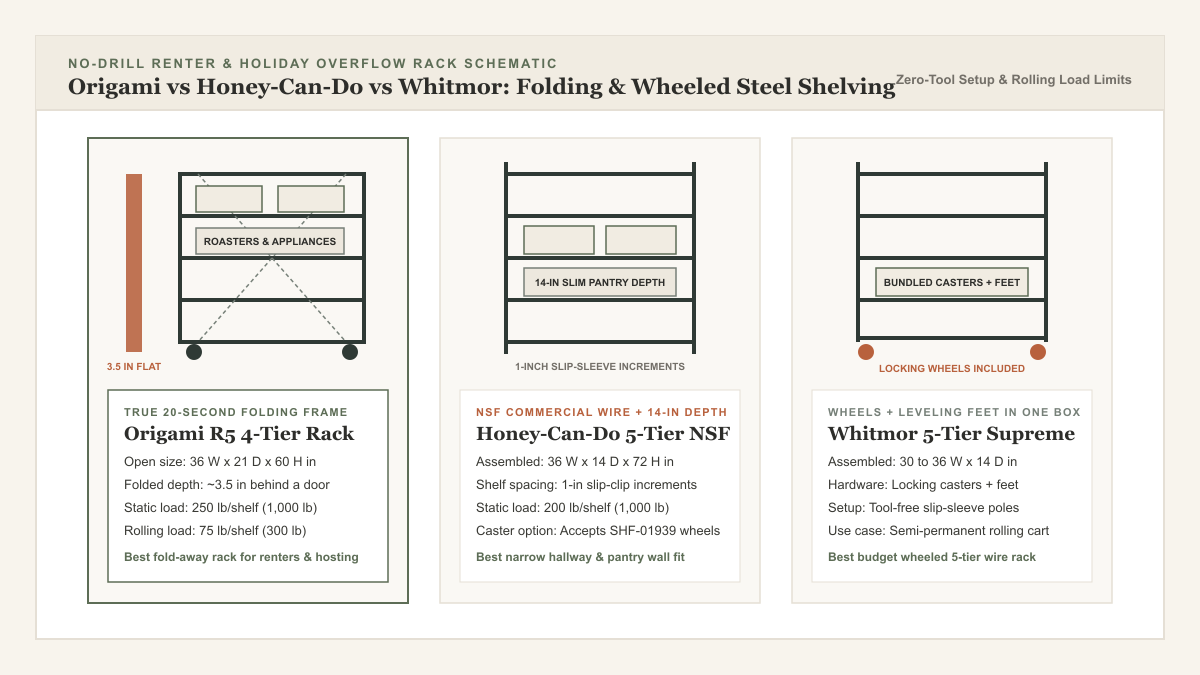
| Criteria | Origami R5 4-Tier Folding Rack | Honey-Can-Do 5-Tier NSF (36x14) | Whitmor 5-Tier Supreme Wheeled |
|---|---|---|---|
| Open dimensions (approx.) | 36 in W x 21 in D x 60 in H | 36 in W x 14 in D x 72 in H | 30.1 in W x 14.25 in D x 59.5 in H |
| Frame architecture | Hinged square-tube accordion steel | Threaded round poles + slip sleeves | Threaded round poles + slip sleeves |
| Setup & takedown time | Under 30 seconds (folds to ~3.5 in flat) | 20 to 30 minutes (does not fold flat) | 20 to 30 minutes (does not fold flat) |
| Shelf height adjustment | Fixed hinged tier heights | 1-inch increments across 72 in posts | 1-inch increments across 59.5 in posts |
| Static load (no wheels) | Up to 250 lb/shelf (1,000 lb total) | 200 lb/shelf (1,000 lb total) | 200 lb/shelf (1,000 lb total) |
| Rolling load (on casters) | 75 lb/shelf (300 lb total rolling) | Optional caster kit sold separately | 200 lb total across entire unit |
| Best household zone | Appliances, roasters, basement totes, renters | Slim pantry walls, canned goods, tall corridors | Tight 30-in apartment alcoves & utility carts |
1. True zero-tool folding vs slip-sleeve wire assembly
Many shoppers buy a wire rack assuming "no tools required" means "folding." On standard wire shelving like Honey-Can-Do and Whitmor, "tool-free" simply means you screw steel pole sections together by hand, snap two-piece tapered plastic wedges around grooved rings at matching heights on all four corners, and press the wire shelf collar down over the plastic sleeves. Once loaded with 150 pounds of canned tomatoes and Dutch ovens, those tapered sleeves wedge tightly into place. Taking the rack apart after New Year's requires unloading every item and tapping all four corners of every shelf upward from underneath with a rubber mallet.
The Origami R5 4-Tier Folding Steel Rack works like heavy steel origami. The side frames, lower three shelves, and top hinged deck arrive permanently riveted at the factory: you screw the four threaded casters into the bottom leg inserts once, pull the sides apart like an accordion, flip the rear center toggle clasp shut, and swing the top deck over its locking pins. When guests leave in January or your apartment lease ends, unlatching two clips folds the entire 60-inch rack down to a ~3.5-inch-thick slab that slides beside a water heater or lays flat across an SUV cargo floor.
2. Static vs rolling weight limits: the caster physics most buyers miss
Every wheeled steel rack carries two completely different engineering ratings: a stationary load rating (weight resting straight down through four steel feet onto a floor) and a dynamic rolling rating (side-load torque exerted on threaded caster stems when a wheel crosses a tile grout line, basement floor crack, or doorway threshold).
- Origami R5 on wheels vs feet: Without casters installed, Origami rates the R5 up to 250 pounds per shelf (1,000 pounds total). Screw in the included casters and rolling capacity becomes 75 pounds per shelf (300 pounds total): still plenty for a 26-pound KitchenAid mixer, two 35-pack sparkling water cases, a turkey roaster, and stacked clear bins, with a full 100-pound margin over lighter 200-pound apartment carts.
- Whitmor 5-Tier Supreme on wheels vs leveling feet: The Whitmor 5-Tier Supreme Wheeled Steel Shelving Unit smartly packs both stationary leveling feet and 4 casters in the same box. On leveling feet, each tier holds up to 200 pounds (1,000 pounds total); on the included casters, the entire five-shelf unit is capped at 200 pounds combined (an average of 40 pounds per shelf).
- Honey-Can-Do 5-Tier NSF 36x14x72 tower: The Honey-Can-Do 5-Tier NSF Steel Wire Shelving Unit ships as a stationary 1,000-pound-rated tower on leveling feet so tall 72-inch pantry loads stay anchored and stable. If you decide later to convert it into a mobile cart, Honey-Can-Do sells heavy-duty 4-inch swivel casters separately that screw into the bottom pole inserts, though tall 14-inch-deep towers are safest kept stationary and wall-strapped when loaded high.
3. Shelf depth & vertical spacing: 14-inch pantry corridors vs 21-inch appliances
Before ordering, measure two things in your kitchen, basement stairwell, or utility room: clear aisle width and the front-to-back footprint of your largest bulky item.
When 21-inch depth wins (Origami R5)
Eighteen-quart electric roaster ovens, air-fryer toaster ovens, Instant Pots, bulk 40-quart latching bins, and warehouse club paper-towel bales routinely measure 16 to 20 inches deep. On a 14-inch wire shelf, they overhang the front rail by 3 to 6 inches and snag sweaters as people walk past. Origami's 21-inch shelf depth swallows wide holiday cookware and double rows of dry-goods bins completely inside the steel perimeter frame, with roughly 15 to 16 inches of fixed vertical clearance between tiers.
When 14-inch depth and 1-inch shelf increments win (Honey-Can-Do & Whitmor)
Fixed 16-inch shelf gaps waste vertical air when you are storing 6-inch-tall canned soup stacks, baking sheets, or 8-inch cereal canisters. Because both Honey-Can-Do and Whitmor adjust in 1-inch increments, you can set a tight 9-inch foil-and-parchment tier, a 12-inch canned-goods tier using FIFO organizers, and an 18-inch bottom bay for 25-pound flour buckets or pet-food tubs. Better yet, a 14-inch shelf depth leaves a comfortable 30-inch walkway in narrow 44-inch utility rooms and walk-in pantries where a 21-inch rack feels cramped. Pair narrow 14-inch wire shelves with firm polypropylene pantry shelf liners so narrow spice jars and oil bottles sit flat without tipping between wire ribs.
4. Basement moisture resistance and renter move-out math
All three picks use powder-coated or epoxy-coated steel rather than laminated particleboard or MDF, making them safe for cool basements, laundry alcoves, and damp concrete utility rooms where pressed wood swells. Keep two practical details in mind:
- Lock casters and load bottom-heavy: Whenever a rack sits on casters, keep the two locking brake wheels on the front corners so you can step on the brake tabs easily, and place beverage cases, canned goods, and Dutch ovens on the bottom two tiers.
- Wall-anchor 72-inch narrow towers: A 72-inch-tall rack that is only 14 inches deep has a 5-to-1 height-to-depth ratio. On stationary setups like Honey-Can-Do, dial the bottom leveling feet plumb and secure an upper anti-tip strap to a wall stud if children or pets share the hallway.
- Coordinate containers before buying bins: Measure the interior clear width between corner posts (typically 1.5 to 2 inches narrower than exterior rack width!) before ordering airtight pantry container sets or clear stackable pantry bins.
Model-by-model buying verdict
Origami R5 4-Tier Folding Steel Rack (Best for zero-tool setup, bulky appliances & renters)
Choose the Origami R5 4-Tier Heavy-Duty Folding Steel Storage Rack if you hate multi-piece assembly, move apartments every year or two, or want temporary high-capacity hosting overflow that disappears flat into a closet in January. Its square-tube frame feels noticeably stiffer when rolled across room thresholds than budget slip-sleeve carts.
Honey-Can-Do 5-Tier NSF 36x14x72 Wire Shelving (Best for permanent narrow pantry walls)
Choose the Honey-Can-Do 5-Tier NSF Heavy-Duty Steel Wire Shelving Unit when you have a dedicated 36-inch-wide wall in a reach-in pantry, basement corridor, or laundry room and want five full-height adjustable tiers that maximize vertical ceiling space up to 6 feet without sticking out past a 14-inch door casing. For full pantry zone layout ideas, pair it with our five-zone kitchen pantry organization guide.
Whitmor 5-Tier Supreme Wheeled Rack (Best budget rolling rack for tight 30-inch corners)
Choose the Whitmor 5-Tier Supreme Wheeled Steel Shelving Unit when a standard 36-inch rack is 4 inches too wide for your apartment nook and you want five adjustable tiers plus included locking wheels at the lowest entry price. Need heavier 48-inch or 77-inch garage-grade steel instead? Step up to our heavy-duty garage shelving comparison.
Frequently Asked Questions
Are Origami folding storage racks actually sturdy enough for heavy kitchen appliances?
Yes. Unlike lightweight tubular laundry carts, the Origami R5 uses hinged square-tube steel rated up to 250 pounds per shelf without wheels (1,000 pounds total) or 75 pounds per shelf on its included casters (300 pounds total), easily supporting stand mixers, cast-iron cookware, and bulk beverage cases.
Do Honey-Can-Do and Whitmor wire shelves fold flat like an Origami rack?
No. Both Honey-Can-Do and Whitmor use threaded vertical steel poles and two-piece plastic slip sleeves. While they assemble without wrenches or screwdrivers, taking them down requires unloading every shelf and tapping each wire deck off its tapered plastic wedges.
Why is the rolling weight limit so much lower than the stationary weight limit on wheeled racks?
Stationary feet transfer weight straight down into the floor, whereas rolling casters concentrate leverage onto threaded steel stems whenever a wheel hits a floor seam or threshold. Always follow the published rolling unit limit (300 pounds total on the Origami R5 and 200 pounds total on the Whitmor 5-Tier Supreme) whenever casters are installed.
Should I choose a 14-inch-deep or 21-inch-deep rack for holiday pantry overflow?
Pick a 14-inch-deep rack like Honey-Can-Do or Whitmor along hallways, basement landings, and narrow walk-in pantries where preserving a 30-inch walkway matters most. Pick Origami's 21-inch-deep R5 when storing wide electric roasters, air fryers, 12-pack soda flats turned lengthwise, or deep storage totes.
How do I keep small spice jars and cans from tipping on wire shelving?
Cut rigid translucent polypropylene shelf liners to match your exact 36-by-14, 30-by-14, or 36-by-21-inch deck, or group small packets and jars inside clear pull-out pantry bins so items glide forward smoothly as a single unit.